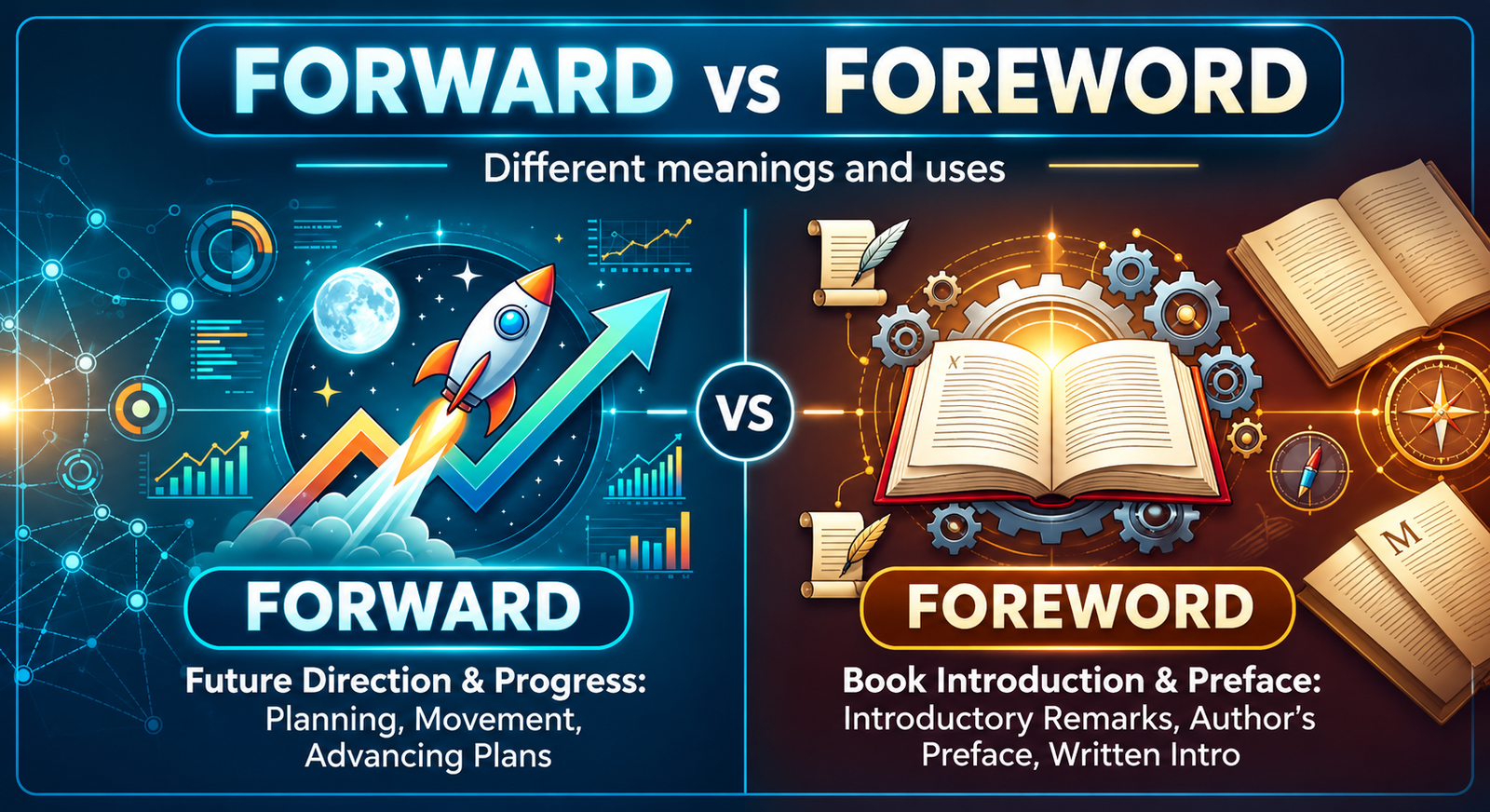
Forward means moving or sending something ahead, while foreword means a short introduction at the beginning of a book.
Imagine you receive an email from your teacher and need to send it to your friend. In this case, you forward the email. However, if you start reading a new book and see a short introduction before Chapter 1, that is the foreword. These two words sound very similar, so English learners often confuse them. However, their meanings are different. Forward is commonly used for movement, progress, emails, messages, and future plans. On the other hand, foreword is mainly used for books and other written works. Therefore, learning the difference between forward or foreword can help you avoid simple spelling mistakes. In this article, you will learn their meanings, pronunciation, examples, common mistakes, history, and everyday use. As a result, you can choose the right word with more confidence.
Pronunciation
- Forward
- US: /ˈfɔːrwərd/
- UK: /ˈfɔːwəd/
- Foreword
- US: /ˈfɔːrwɝːd/
- UK: /ˈfɔːwɜːd/
A Simple Way to Remember
Now let’s look at the main differences between these two words.
Difference Between Forward and Foreword
1. Basic meaning
Forward means moving ahead, sending something on, or looking toward the future.
For example:
- Please forward this email to Sara.
- The team moved forward with the plan.
Foreword, however, is a short text at the beginning of a book.
For example:
- The author asked her teacher to write the foreword.
- I read the foreword before starting the book.
2. Part of speech
Forward can work as an adverb, adjective, verb, and sometimes a noun. For example:
- Walk forward slowly.
- Please forward the message.
In contrast, foreword is a noun.
For example:
- The foreword is only two pages long.
- She wrote the book’s foreword.
3. Use with movement
Forward can describe movement toward the front or ahead.
For example:
- Take one step forward.
- The car moved forward.
However, foreword does not describe movement.
For example:
- The foreword explains the book.
- I skipped the foreword.
4. Use with emails and messages
Forward is common when sending a message to another person.
For example:
- I will forward the email.
- Please forward the file to me.
On the other hand, foreword is not used for emails.
Instead, it is used for books:
- The book has a short foreword.
- The writer added a foreword to the new edition.
5. Use in books
Foreword is closely linked to books. Usually, it is a short introduction before the main text.
For example:
- The professor wrote the foreword.
- The foreword gives background about the book.
Forward can also appear in books, but it has a different meaning.
For example:
- The story moves forward quickly.
- The writer looks forward to the next chapter.
6. Use for future plans
Forward can describe progress toward the future.
For example:
- We need to move forward.
- She is looking forward to the holiday.
However, foreword does not have this meaning.
Instead:
- The foreword introduces the book.
- He wrote the foreword last week.
7. Spelling
Forward has the ending -ward. This ending often relates to direction.
For example:
- Move forward.
- Look forward.
Foreword, however, contains fore + word.
For example:
- Read the foreword.
- The foreword comes before the main text.
8. Meaning in communication
Forward can mean to send information to someone else.
For example:
- Forward the message to your manager.
- I forwarded the document yesterday.
In contrast, foreword is a written introduction.
For example:
- The writer added a foreword.
- The foreword was written by a famous teacher.
9. Meaning in writing
Forward can describe progress.
For example:
- The project is moving forward.
- We should move forward carefully.
On the other hand, foreword describes a part of a book.
For example:
- The foreword appears before Chapter 1.
- I enjoyed reading the foreword.
10. Grammar
Forward changes form depending on its use.
For example:
- They moved forward.
- She forwarded the email.
Meanwhile, foreword is mainly used as a noun.
For example:
- I read the foreword.
- The foreword was helpful.
Nature and Behaviour of These Two Words
Forward
Forward is a flexible word. It can describe movement, progress, direction, communication, or future plans. Also, it is common in daily English.
Foreword
Foreword is a specific book-related word. It means a short introduction placed before the main part of a book. It is often written by someone other than the main author.
Why People Get Confused About These Words
The two terms sound very similar. Their spellings are also close. Therefore, many English learners mix them up.
The easiest way to remember them is:
- Forward = move or send ahead
- Foreword = a word before the main book
Think of foreword as fore + word. Here, “fore” can mean “before” or “in front of.”
Comparison Table
| Feature | Forward | Foreword |
|---|---|---|
| Meaning | Move or send ahead | Book introduction |
| Part of speech | Adverb, adjective, verb, noun | Noun |
| Main use | Movement, progress, messages | Books |
| Example | Forward the email | Read the foreword |
| Related idea | Ahead | Before the main text |
| Common setting | Daily speech and writing | Books and publishing |
The Origin of These Words
Forward
Forward comes from Old English foreweard, meaning “toward the front” or “toward the future.” It developed from fore, meaning “before,” and -ward, meaning “in the direction of.”
Over time, its meaning became wider. Today, it can describe direction, progress, future time, and sending information.
Foreword
Foreword is made from fore and word. Therefore, the basic idea is simple: it is a word before the main text.
Over time, it became a term for a short introduction placed at the beginning of a book.
British vs American English
The meanings of these terms are generally the same in British and American English.
However, there is one small difference with forward:
- American English commonly uses forward.
- British English may use forward or forwards.
For example:
- US: She walked forward.
- UK: She walked forward.
- UK: She walked forwards.
Foreword, however, keeps the same spelling and meaning in both forms of English.
Which One Should You Use?
Use forward when you mean moving ahead, making progress, sending something, or thinking about the future.
In contrast, use foreword when you mean a short introduction at the beginning of a book.
For global English, remember these simple rules:
- Movement → forward
- Email or file → forward
- Progress → forward
- Book introduction → foreword
Common Mistakes
- ❌ Please foreword this email.
- ✅ Please forward this email.
- ❌ I read the book’s forward.
- ✅ I read the book’s foreword.
- ❌ We need to move foreword.
- ✅ We need to move forward.
- ❌ The professor wrote the book’s forward.
- ✅ The professor wrote the book’s foreword.
Everyday Usage Examples
“Please forward the email to the sales team.”
Social Media
“Looking forward to the weekend!”
News
“The country is moving forward with the new plan.”
Formal Writing
“The professor wrote the foreword for the new edition.”
Books
“Please read the foreword before starting Chapter 1.”
Usage Trends
Forward is much more common in everyday English because people use it for movement, progress, communication, and future plans.
Foreword, however, is less common because it is mainly used when talking about books, reports, or other long written works.
Therefore, you will see forward much more often in daily communication.
Metaphors and Similes
Forward is often used in a figurative way to describe progress.
For example:
- “The project is moving forward.”
- “She is taking a step forward in her career.”
A simple comparison is:
- “The team moved forward like a car leaving a busy road.”
Foreword, on the other hand, is usually literal. It names a part of a book rather than describing an action.
Connotative Meaning
Forward
- Positive: progress, growth, and action.
- Negative: in some contexts, “forward” can describe someone who is too direct or bold.
- Neutral: movement or direction.
Foreword
- Positive: knowledge, support, and guidance.
- Negative: it usually has no strong negative meaning.
- Neutral: a book introduction.
Idioms and Proverbs
Forward appears in several common expressions.
Look forward to
This means to feel happy about something that will happen.
For example:
“I look forward to meeting you.”
Move forward
This means to continue or make progress.
For example:
“We need to move forward with the plan.”
Step forward
This means to offer help or take action.
For example:
“She stepped forward to help the team.”
There are no major common idioms using foreword because it is a specific book term.
Literature and Movies
The word foreword is common in books, especially biographies, history books, memoirs, and academic works. In addition, a foreword may be written by a respected person who introduces the author’s work.
The word forward is also common in stories and novels because it can describe movement, progress, and future events.
Similarly, movies may use forward in dialogue, such as “move forward” or “looking forward.” However, foreword is less common in spoken movie dialogue because it mainly refers to books.
Why This Difference Matters
Knowing the difference between these words helps English learners avoid spelling mistakes. It also helps writers use the correct word in emails, school work, reports, and book-related writing.
Using the wrong word can change the meaning of a sentence. A reader may understand the sentence from context, but the spelling can still look incorrect.
Learning small differences like this can make your English writing clearer and more accurate.
Usefulness in Daily Life
You may use forward when:
- Sending an email
- Sending a file
- Talking about progress
- Giving directions
- Talking about future plans
- Describing movement
In contrast, you may use foreword when:
- Reading a book
- Writing a book
- Talking about publishing
- Discussing an introduction written by another person
Situational Preference
Use forward in most daily situations. It is the correct word for movement, progress, sending emails, and future plans. For example, you can forward a message or move forward with a project. However, use foreword only when talking about a short introduction at the beginning of a book or similar written work. If you are unsure, first look at the meaning of the sentence. When the idea is “ahead” or “send,” choose forward. On the other hand, when the idea is “a word before the main book,” choose foreword.
Possible Questions
What does forward mean?
Forward means toward the front, ahead, or toward the future. It can also mean to send something to another person.
What does foreword mean?
A foreword is a short introduction at the beginning of a book.
Are forward and foreword pronounced the same?
They are very similar in pronunciation. However, they have different meanings and spellings.
Can I say “forward an email”?
Yes. Forward an email means to send an email you received to another person.
Can foreword be used for an email
No. Use forward when you mean sending an email.
Is a foreword part of a book?
Yes. A foreword usually appears near the beginning of a book, before the main text.
How can I remember the difference?
Remember foreword = fore + word. It is a “word before” the main book. In contrast, forward means moving or sending ahead.
Conclusion
The difference between forward and foreword is simple once you understand their meanings. Forward is used for moving ahead, making progress, sending messages, and talking about the future. However, foreword is a short introduction at the beginning of a book. The two words can sound very similar, which is why many English learners confuse them. Even so, their uses are different. Therefore, remember the easy rule: forward means ahead, while foreword means a word before the main text. Knowing this difference can improve your spelling, writing, and daily communication. It can also help you write clearer emails, school work, reports, and book-related content. Finally, practice both words in simple sentences. With regular practice, you will remember the difference and use each word with confidence.

I’m Khadija Zafar, a content writer and blogger. I write simple, engaging articles on English grammar, word meanings, synonyms, antonyms, and vocabulary to help readers improve their English skills.







2 thoughts on “Forward or Foreword: Easy Difference, Meaning, and Examples”