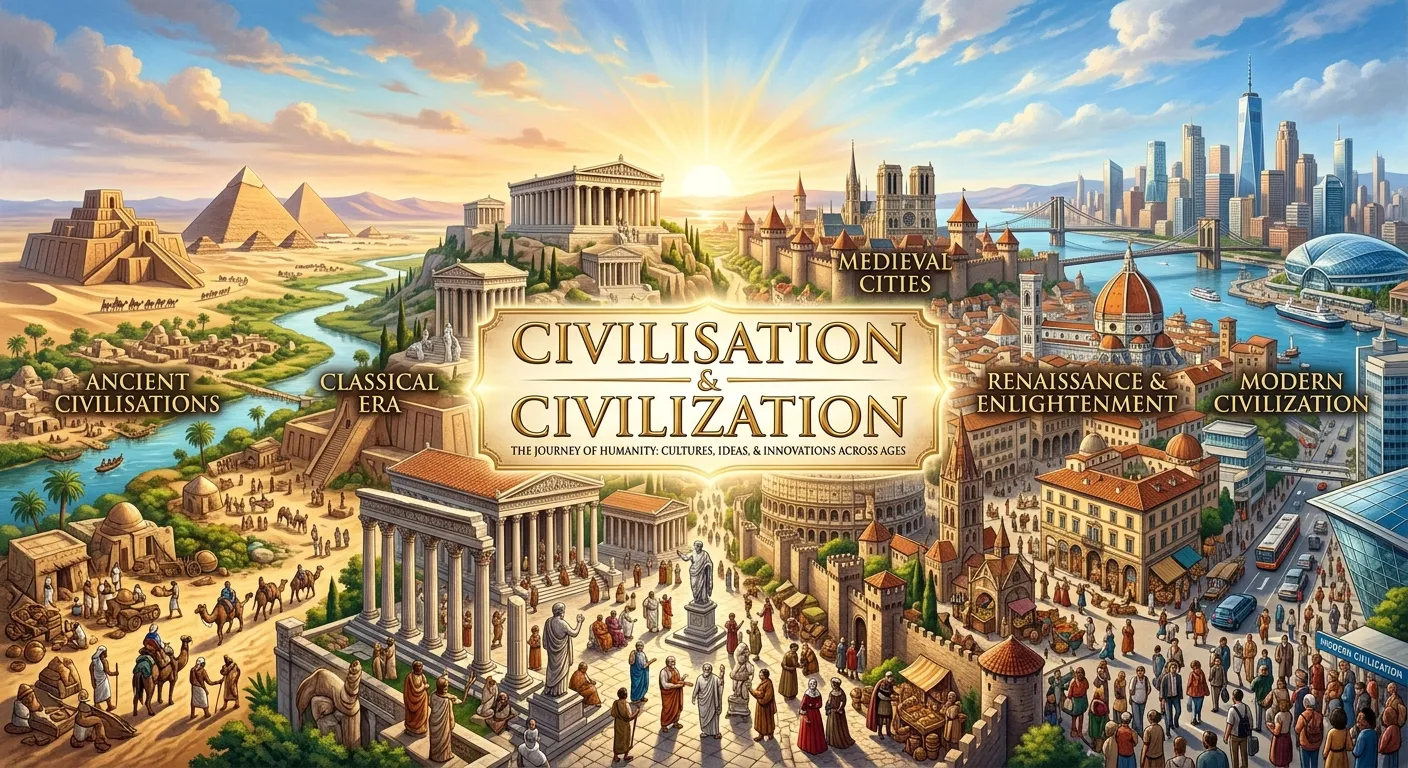
Civilisation and civilization are the same word. They have the same meaning. The main difference is the spelling.
Think about a school history class. Your teacher asks you to write about old Egypt. You may write civilisation if your school uses British English. You may write civilization if your school uses American English. Both spellings are right.
The word means a group of people who live in an organized way. A civilisation can have cities, laws, schools, art, trade, and a system of rule. Ancient Egypt is one example. Ancient Rome and Ancient Greece are other examples.
Many people search for civilisation or civilization because they see both spellings. They may think that one spelling is wrong. That is not true.
British English usually uses civilisation. American English usually uses civilization. The only main change is the letter s or z.
This guide explains the difference in very simple English. It also gives examples, spelling tips, history, and common mistakes. By the end, you will know which form to use.
Pronunciation
Both words are said in almost the same way.
Civilisation
- UK: /ˌsɪvəlaɪˈzeɪʃən/
- US: /ˌsɪvələˈzeɪʃən/
Civilization
- UK: /ˌsɪvəlaɪˈzeɪʃən/
- US: /ˌsɪvələˈzeɪʃən/
The spelling is different, but the sound is very close.
Difference Between Civilisation or Civilization
1. British English
Civilisation is the usual British spelling.
British English uses s in this word.
Examples:
- Ancient civilisation was very strong.
- Roman civilisation was very important.
2. American English
Civilization is the usual American spelling.
American English uses z in this word.
Examples:
- Ancient civilization was very strong.
- Roman civilization was very important.
3. The Spelling
There is only one main letter change.
Civilisation has s.
Civilization has z.
Examples:
- civilisation = British
- civilization = American
This is the easiest way to remember the difference.
4. The Meaning
Both words have the same meaning.
They can mean a human society.
Examples:
- Egypt had an old civilisation.
- Egypt had an old civilization.
The two sentences mean the same thing.
5. The Word Type
Both words are nouns.
A noun is a word for a person, place, thing, or idea.
Examples:
- The civilisation was large.
- The civilization was large.
Both words name a human society.
6. School Use
Students may see either spelling at school.
The spelling depends on the English style used by the school.
Examples:
- A British school may use civilisation.
- An American school may use civilization.
Always follow your teacher’s rule.
7. Book Use
Books from the UK often use civilisation.
Books from the US often use civilization.
Examples:
- British book: Ancient civilisation.
- American book: Ancient civilization.
Both forms are correct.
8. Website Use
Websites may use either spelling.
A UK website may use civilisation.
A US website may use civilization.
Examples:
- UK: History of ancient civilisation.
- US: History of ancient civilization.
The meaning does not change.
9. Same Meaning
Do not think these are two different words.
They are the same word.
Examples:
- Ancient civilisation
- Ancient civilization
Both can talk about an old human society.
10. Both Are Correct
The two forms are correct.
Civilisation ✓
Civilization ✓
Your choice depends on the type of English you use.
Nature and Behaviour of Civilisation and Civilization
Both words talk about human society.
A civilisation can have many parts.
It may have:
- People
- Cities
- Homes
- Schools
- Laws
- Art
- Trade
- Science
- Language
- Leaders
For example, Ancient Egypt had cities, farms, temples, rulers, and a system of writing.
The word does not mean only one thing. It can talk about a whole society and the way people live.
Civilisation and civilization do not describe two different societies. They are two spellings of the same word.
Why People Get Confused About Civilisation or Civilization
People get confused because they see two spellings.
One spelling has s.
The other spelling has z.
For example:
- civilisation
- civilization
Both are correct.
British English often uses s in words like this.
American English often uses z.
You can see the same type of change in other words.
For example:
- organisation / organization
- realisation / realization
- civilisation / civilization
This is why both forms appear in English writing.
Comparison Table
| Point | Civilisation | Civilization |
|---|---|---|
| English style | British | American |
| Letter | s | z |
| Meaning | Same | Same |
| Word type | Noun | Noun |
| Correct | Yes | Yes |
| Common in UK | Yes | Less common |
| Common in US | Less common | Yes |
| Main use | Human society | Human society |
The table shows that the main difference is spelling.
The Origin of Civilisation or Civilization
The word has a long history.
It comes from Latin. The old Latin word civilis was linked to citizens and public life. Another related word was civitas. It was linked to a city or group of people.
The idea later moved into other languages.
It came into English over time.
The word became linked to organized human life. It could talk about cities, people, laws, culture, and ways of living.
Today, the word is often used when we talk about history.
Examples include:
- Egyptian civilisation
- Greek civilisation
- Roman civilisation
- Maya civilization
The spelling may change, but the basic meaning stays the same.
British vs American English
British and American English use different spellings for some words.
This is one example.
British English
British English usually uses:
civilisation
Example:
“Ancient civilisation is an interesting topic.”
American English
American English usually uses:
civilization
Example:
“Ancient civilization is an interesting topic.”
The meaning is the same.
The main change is the letter s or z.
More Examples
British:
- civilisation
- organisation
- realisation
American:
- civilization
- organization
- realization
This pattern can help English learners.
Which One Should You Use?
The best choice depends on your English style.
If You Use British English
Use civilisation.
Example:
“Ancient civilisation was very important.”
If You Use American English
Use civilization.
Example:
“Ancient civilization was very important.”
If You Write for a Global Audience
You can use either form.
Still, it is better to choose one form and use it all through your text.
Do not change from s to z for no reason.
Common Mistakes
Mistake 1: Saying Civilisation Is Wrong
❌ Civilisation is wrong.
✅ Civilisation is correct in British English.
Mistake 2: Saying Civilization Is Wrong
❌ Civilization is wrong.
✅ Civilization is correct in American English.
Mistake 3: Mixing the Two Forms
❌ Ancient civilisation was great. The civilization had many cities.
✅ Ancient civilisation was great. The civilisation had many cities.
Or:
✅ Ancient civilization was great. The civilization had many cities.
Mistake 4: Thinking the Meaning Is Different
❌ The two words have different meanings.
✅ The two words have the same meaning.
Mistake 5: Using the Wrong School Style
If your school uses British English, use civilisation.
If your school uses American English, use civilization.
Everyday Usage Examples
These words can be used in many types of writing.
In an Email
“I am writing about ancient civilisation.”
American style:
“I am writing about ancient civilization.”
On Social Media
“Ancient civilizations had great cities.”
British style:
“Ancient civilisations had great cities.”
In the News
“Experts found signs of an ancient civilization.”
British style:
“Experts found signs of an ancient civilisation.”
In Formal Writing
“Ancient civilisation had a big role in human history.”
American style:
“Ancient civilization had a big role in human history.”
In School Work
“Egyptian civilisation is an important history topic.”
American style:
“Egyptian civilization is an important history topic.”
Usage Trends
Both spellings are still used today.
British English often uses civilisation.
American English often uses civilization.
Many schools around the world teach British English.
Other schools teach American English.
People may also see both forms on the internet.
For example, a UK website may write civilisation. A US website may write civilization.
The choice can also depend on the writer.
A writer should know the style of the audience.
If the readers are mainly from the UK, civilisation may look more natural.
If the readers are mainly from the US, civilization may look more natural.
For SEO writing, both spellings can be useful. People in different places may search for different forms.
Metaphors and Similes
The word can also be used in creative writing.
A metaphor says that one thing is another thing.
Example:
“Our city is a small civilisation.”
This sentence compares the city to a full human society.
A simile uses like or as.
Example:
“The old town was like a lost civilisation.”
This sentence compares the town to an old society.
Another example is:
“The small island was like a tiny civilisation.”
These examples show how the word can be used in creative writing.
Connotative Meaning
The word can give different feelings in different sentences.
Positive Meaning
It may give ideas of:
- Learning
- Art
- Science
- Culture
- Peace
- Progress
Example:
“The civilisation made great progress in science.”
Here, the word gives a good feeling.
Negative Meaning
It may also be linked to:
- War
- Death
- Damage
- Loss
- Fall
Example:
“The war destroyed the old civilisation.”
Here, the word gives a sad feeling.
Neutral Meaning
Sometimes the word is simply a fact.
Example:
“Historians study ancient civilisation.”
There is no strong good or bad feeling here.
Idioms and Proverbs
There is no common English idiom that uses civilisation or civilization.
The word is more common in history, school work, books, and news.
Here are some simple sentences:
“Every civilization has a story.”
“Civilisation changes over time.”
“Ancient civilization left many old buildings.”
These are normal sentences, not special idioms.
Literature and Movies
The idea of civilisation is common in books and movies.
Literature
Sapiens: A Brief History of Humankind is a book by Yuval Noah Harari. It was first published in 2011.
The book talks about humans and the way human societies grew.
Another well-known book is The Decline and Fall of the Roman Empire by Edward Gibbon. The first volume came out in 1776.
It talks about the history of Rome.
Movies
The Mummy came out in 1999. It is an American movie. The story uses ideas about ancient Egypt.
Gladiator came out in 2000. It is a historical movie about ancient Rome.
These books and movies can help people become more interested in old societies and history.
Why This Difference Matters
This small spelling difference is useful for English learners.
You may read a British book and see civilisation.
You may then read an American book and see civilization.
Without this knowledge, you may think one word is wrong.
Now you know that both are correct.
This knowledge is also useful for students.
It can help them use the right spelling in school work.
Writers can also use this knowledge when they write for different readers.
A British reader may expect civilisation.
An American reader may expect civilization.
The difference is small, but it helps make writing clear.
Usefulness in Daily Life
You can see these words in many places.
School
Students may study ancient civilisation in history class.
Books
History books often talk about old civilizations.
News
News stories may talk about old cities and human societies.
Websites
History websites may use either spelling.
Social Media
People may use these words when they talk about history.
Essays
Students may use the word in history essays.
Knowing both forms helps you read more easily.
Situational Preference
Use civilisation when you write in British English. This is the normal form in the UK. Use civilization when you write in American English. This is the normal form in the US. Your school may tell you which English style to use. Follow that rule. Your company may also have a writing style. Follow it when needed. If nobody gives you a rule, choose one form. Then use the same form from start to end. Do not change the spelling in the middle of your work. Both forms are correct. The choice is about English style, not meaning.
Possible Question
Is civilisation correct?
Yes. Civilisation is correct. It is the usual British English spelling.
Is civilization correct?
Yes. Civilization is correct. It is the usual American English spelling.
Do civilisation and civilization mean the same thing?
Yes. They have the same basic meaning.
Which spelling is British?
Civilisation is the British spelling.
Which spelling is American?
Civilization is the American spelling.
Can I use civilisation in the US?
You may see it, but civilization is the normal American form.
Can I use civilization in the UK?
You may see it, but civilisation is the normal British form.
Which spelling should I use in school?
Use the style your school or teacher asks for. If your school uses British English, use civilisation. If it uses American English, use civilization.
Is the pronunciation different?
The pronunciation is very close. The main difference is the spelling.
Why does one use S and the other use Z?
This comes from different spelling styles in British and American English.
Conclusion
Civilisation and civilization have the same meaning. The only difference is the spelling. Civilisation is used in British English. Civilization is used in American English. Both words talk about people, culture, and society.Use civilisation when you follow British English. Use civilization when you follow American English. Both spellings are correct. The word also has the same pronunciation in both forms.If you are writing for a school, website, or blog, choose the spelling that matches your readers. The most important thing is to use one spelling style in your writing. This makes your work clear and easy to read.

I’m Khadija Zafar, a content writer and blogger. I write simple, engaging articles on English grammar, word meanings, synonyms, antonyms, and vocabulary to help readers improve their English skills.








1 thought on “Civilisation or Civilization: What Is the Difference?”