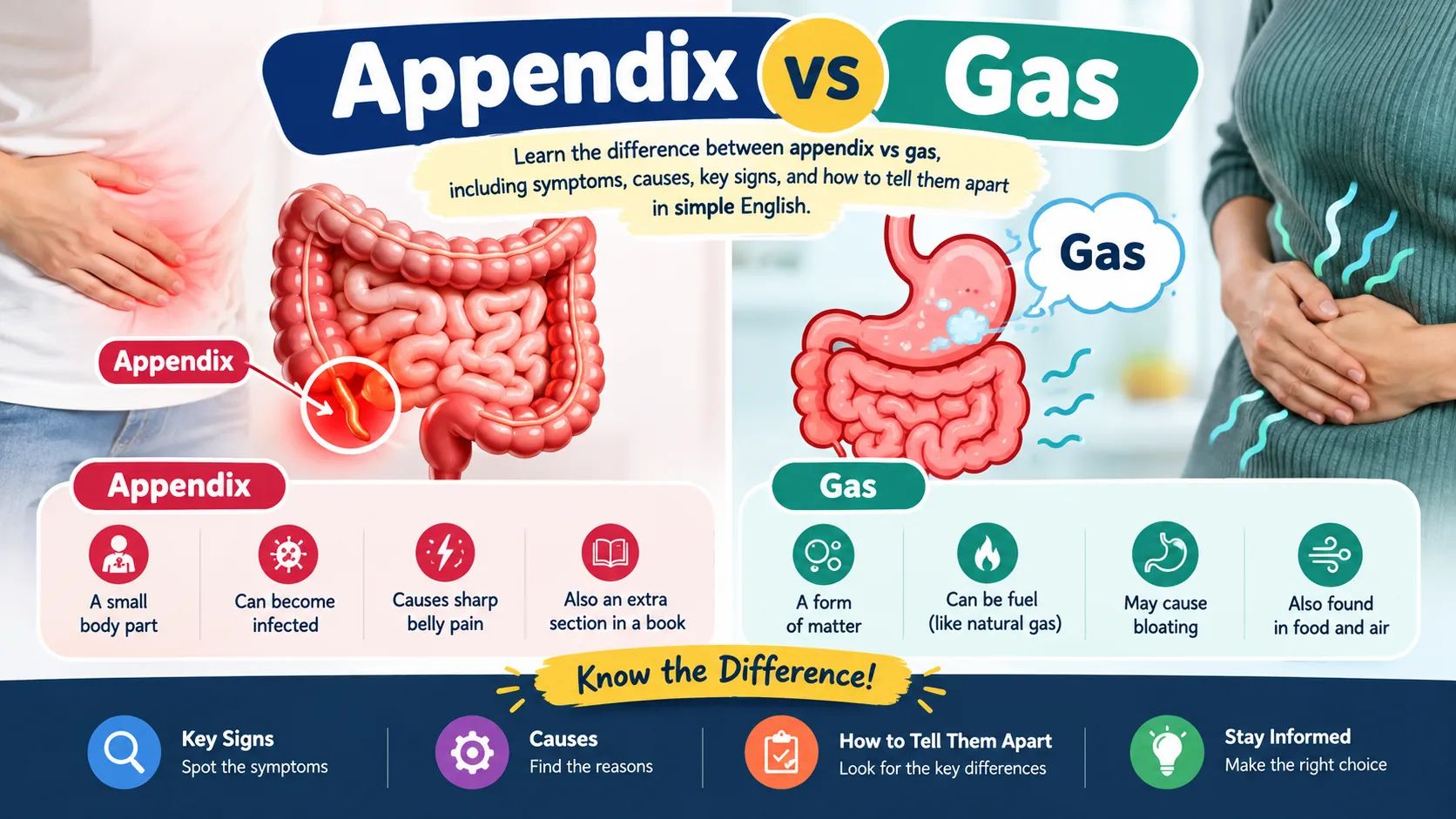
An appendix is a small body part or an extra section in a book. Gas is a form of matter or a type of fuel.
Imagine reading a science book. At the end, you find extra facts in a section called an appendix. Later, you hear someone say that gas is used to cook food. Both words have different meanings and uses.
The word appendix is often used in health and writing. In the body, it is a small pouch attached to the large intestine. In a book, it gives extra facts or notes. The word gas is used in science, cooking, cars, and health. Air contains gases, and natural gas can help people cook meals.
People search for Appendix vs Gas to learn about these words or understand belly pain. Gas can cause bloating and cramps. Appendicitis is a problem that affects the appendix. Knowing the difference helps people use the right words. This guide explains their meanings, sounds, uses, and common mistakes in easy English.
Pronunciation
- Appendix
- US: /əˈpɛndɪks/
- UK: /əˈpɛndɪks/
- Syllables: 3
- Gas
- US: /ɡæs/
- UK: /ɡæs/
- Syllables: 1
The words sound different and have different meanings.
Difference Between Appendix and Gas
1. Meaning
An appendix is a body part or an extra section in a book. Gas is a form of matter or fuel.
- The doctor checked my appendix.
- We use gas to cook food.
2. Use in Science
The appendix is part of the human body. Gas is one of the main forms of matter.
- The appendix is near the large intestine.
- Oxygen is a gas.
3. Use in Health
The appendix can become swollen or infected. Gas can build up in the stomach or intestines.
- Appendicitis can cause belly pain.
- Gas can make your stomach feel full.
4. Use in Books
An appendix can give extra facts at the end of a book. Gas may be a topic in a science book.
- The report has an appendix with charts.
- The book explains how gas works.
5. Physical Form
The body appendix is a small pouch. Gas spreads out to fill the space around it.
- The appendix is part of the body.
- Gas spreads through an open container.
6. Daily Use
The word appendix often comes up in health or school work. The word gas is common in homes and cars.
- I read about the appendix in a health book.
- The car needs gas before the trip.
7. Meaning in a Sentence
The meaning of appendix depends on the topic. Gas may mean matter, fuel, or gas in the body.
- Please read the appendix at the end of the report.
- The gas filled the balloon.
8. Related Words
Words linked to appendix include appendicitis and appendices. Words linked to gas include gaseous and gases.
- Appendicitis can cause strong belly pain.
- Air contains different gases.
9. Health Problems
An appendix problem may need urgent care. Gas pain is often mild, but belly pain can have many causes.
- The doctor checked for appendicitis.
- Gas caused mild bloating.
10. Grammar
Appendix is a noun. Its plural forms are appendices and appendixes. Gas is also a noun. Its plural is gases.
- The book has two appendices.
- Air contains several gases.
Nature and Behaviour of Appendix and Gas
Appendix
The appendix is a small pouch attached to the large intestine. It is part of the digestive system. It can become swollen or infected. This problem is called appendicitis.
The word also has a use in books. An appendix at the end of a report may contain charts, notes, or extra facts.
- The doctor examined her appendix.
- The report has an appendix with extra facts.
Gas
Gas is a state of matter. It has no fixed shape and spreads to fill its space. Air contains gases such as oxygen and nitrogen.
Gas can also mean fuel. Many homes use natural gas for cooking. In the body, gas can cause bloating and cramps.
- Oxygen is a gas.
- Gas helps the family cook dinner.
Why People Get Confused About Appendix and Gas
People may confuse these words when talking about belly pain. Gas can cause cramps and bloating. Appendicitis can also cause pain in the belly.
However, they are not the same. Gas may form during digestion. Appendicitis affects the appendix and can become serious.
Appendicitis may start near the belly button. The pain may later move to the lower right side. It can get worse over time.
Important: Do not assume that strong belly pain is only gas. Severe or worsening pain needs urgent medical care. A doctor can check the cause.
Comparison Table
| Feature | Appendix | Gas |
|---|---|---|
| Meaning | Body part or book section | Matter or fuel |
| Word type | Noun | Noun |
| Health use | Part of the digestive system | Can build up in the gut |
| Science use | A body structure | A form of matter |
| Book use | Extra facts at the end | May be a topic in a book |
| Plural | Appendices or appendixes | Gases |
| Related health issue | Appendicitis | Gas pain or bloating |
| Example | The appendix is in the body. | Oxygen is a gas. |
The Origin of Appendix and Gas
Origin of Appendix
The word appendix comes from Latin. It is linked to a word that means something added or attached. This meaning fits both uses of the word.
In the body, the appendix is attached to the large intestine. In a book, an appendix is added to the end of the main text.
Today, the word is common in health books, school work, and reports.
Origin of Gas
The word gas became known in science through the work of chemist Jan Baptist van Helmont in the 1600s. He used it to describe substances released in certain processes.
Over time, the word became common in science and daily speech. Today, it can mean a form of matter, fuel, or gas in the body.
British vs American English
British and American English use the same spelling for appendix and gas.
| Word | British English | American English |
|---|---|---|
| Appendix | Appendix | Appendix |
| Gas | Gas | Gas |
| Plural of appendix | Appendices or appendixes | Appendices or appendixes |
| Plural of gas | Gases | Gases |
| Car fuel | Petrol | Gas |
Examples:
- UK: The doctor checked my appendix.
- US: The doctor checked my appendix.
- UK: My car needs petrol.
- US: My car needs gas.
The main difference is the word used for car fuel. The spelling of appendix and gas stays the same.
Also read more about https://textlinkerpro.com/eufy-or-ring/
Which One Should You Use?
Choose the word that fits your meaning.
- For health: Use appendix for the body part and gas for gas in the digestive system.
- For books: Use appendix for extra information at the end.
- For science: Use gas for matter that spreads to fill its space.
- For car fuel: Use gas in the US and petrol in the UK.
- For global readers: Add details when a word may have more than one meaning.
These words cannot replace each other. Your topic should guide your choice.
Common Mistakes
Here are some common mistakes and their corrections.
Mistake 1
Incorrect: The appendix filled the balloon.
Correct: The gas filled the balloon.
Mistake 2
Incorrect: Read the gas at the end of the report.
Correct: Read the appendix at the end of the report.
Mistake 3
Incorrect: The air has many gas.
Correct: The air contains many gases.
Mistake 4
Incorrect: The book has two appendix.
Correct: The book has two appendices.
Mistake 5
Incorrect: My belly hurts, so it must be gas.
Correct: Belly pain can have many causes. A doctor can check the cause.
Everyday Usage Examples
In Emails
- Please check the appendix in the report.
- The gas supply will be checked tomorrow.
On Social Media
- I added the charts to the appendix.
- Why have gas prices gone up?
In News Reports
- Doctors treated the patient for appendicitis.
- Recent reports explain changes in gas prices.
In Academic Writing
- The appendix contains extra study data.
- A separate report explains how gases react to hea
Everyday Conversation
- The doctor checked my appendix.
- Gas made my stomach feel full.
Usage Trends
The word appendix is common in medical books, school work, and reports. In a book, it often means an extra section at the end. In health talks, it means the body part.
The word gas is common in science, energy news, cooking guides, and health talks. People use it to talk about fuel, matter, and stomach problems.
American speakers often use gas for car fuel. British speakers usually say petrol.
The two words have different uses. They are not competing words, and neither is a replacement for the other.
Metaphors and Similes
A metaphor compares two things. A simile uses like or as.
Appendix
The word appendix can refer to extra details added after the main part.
- The extra notes were an appendix to the story.
- Her list of facts felt like an appendix to the speech.
Gas
The phrase running out of gas can mean losing energy.
- I was running out of gas after a long day.
- The team ran out of gas near the end of the game.
These examples show how the words can be used in a wider sense.
Connotative Meaning
Connotation is the feeling a word brings to mind.
Appendix
- Neutral: The doctor checked the appendix.
- Negative: The patient feared an appendix operation.
- Positive: The appendix gave readers useful facts.
Gas
- Neutral: Oxygen is a gas.
- Negative: The gas leak caused fear.
- Positive: Gas helped the family cook a meal.
The feeling depends on the sentence and the situation.
Idioms and Proverbs
There are no common proverbs that directly compare appendix and gas. However, gas appears in some common phrases.
Running Out of Gas
This means losing energy.
Example: I was running out of gas after work.
Step on the Gas
This means pressing the gas pedal to make a car go faster. It can also mean working faster.
Example: We need to step on the gas to finish on time.
Full of Hot Air
This means talking a lot without saying anything useful.
Example: His promises were full of hot air.
The word appendix is mostly used in health and writing, so it has fewer common idioms.
Literature and Movies
The word appendix is common in science books, reports, and study guides. Writers use appendices to share extra notes, facts, and charts.
The word gas appears in science books, news stories, and novels. It may refer to fuel, air, or gas in the body.
The 2006 American documentary An Inconvenient Truth discusses climate change and greenhouse gases. This is one example of gas-related topics in film.
In medical dramas, characters may discuss the appendix, appendicitis, or surgery. The exact use depends on the story.
Why This Difference Matters
Knowing the difference helps you use the right word. It also helps you understand books, science lessons, and health information.
A student may see appendix in a book. It may mean a body part or extra information at the end. The sentence helps show the meaning.
The word gas also has more than one use. It can mean matter, fuel, or gas in the digestive system.
Clear word use can prevent confusion in school work, reports, and daily talks. It is also important when discussing health. Belly pain can have many causes, so it is not safe to guess that pain is only gas.
Usefulness in Daily Life
These words are useful in many situations.
- At school: Learn about the appendix in biology and gas in science.
- At work: Add an appendix to a report with extra facts.
- At home: Talk about gas when discussing cooking fuel.
- At a hospital: Use appendix when talking about the body part.
- When reading: Check whether appendix means a body part or a book section.
- When writing: Choose the word that matches your meaning.
These simple rules can make your English clearer.
Situational Preference
The right word depends on the situation. Use appendix when you mean the small pouch attached to the large intestine or an extra section in a book. Use gas when you mean a form of matter, fuel, or gas in the digestive system. In American English, gas often means car fuel. In British English, petrol is more common. When writing for global readers, give enough details to make your meaning clear. Never use appendix and gas as if they mean the same thing.
Possible Question
1. What is the main difference between appendix and gas?
An appendix is a body part or a section in a book. Gas is a form of matter or fuel.
2. Can gas cause pain near the appendix?
Yes. Gas can cause belly pain, but other problems can cause it too. A doctor can check the cause.
3. What is appendicitis?
Appendicitis is swelling or infection of the appendix. It can cause belly pain and needs urgent medical care.
4. Is gas the same as appendicitis?
No. Gas can cause bloating and cramps. Appendicitis affects the appendix and can become serious.
5. What does appendix mean in a book?
It means an extra section at the end of a book or report. It may contain charts, notes, or facts.
6. Do British and American speakers spell these words differently?
No. Both use the same spelling. However, British speakers often say petrol for car fuel, while Americans say gas.
7. What are the plural forms?
The plural of appendix is appendices or appendixes. The plural of gas is gases.
Conclusion
Appendix and gas have different meanings and uses. An appendix is a small part of the body or an extra section at the end of a book. Gas is a form of matter or a type of fuel. It can also build up in the digestive system.you may see appendix in a medical report or school book. You may hear gas when people talk about cooking, cars, science, or stomach pain. Both words are useful in daily life.British and American English use the same spelling for these words. The main difference is how people use gas to talk about car fuel. Americans often say gas, while British speakers usually say petrol.Remember to choose the word that fits your meaning. Do not assume that belly pain is only gas. Strong or worsening pain needs urgent medical care. Learning these simple differences can help you speak and write with more care.

I’m Khadija Zafar, a content writer and blogger. I write simple, engaging articles on English grammar, word meanings, synonyms, antonyms, and vocabulary to help readers improve their English skills.