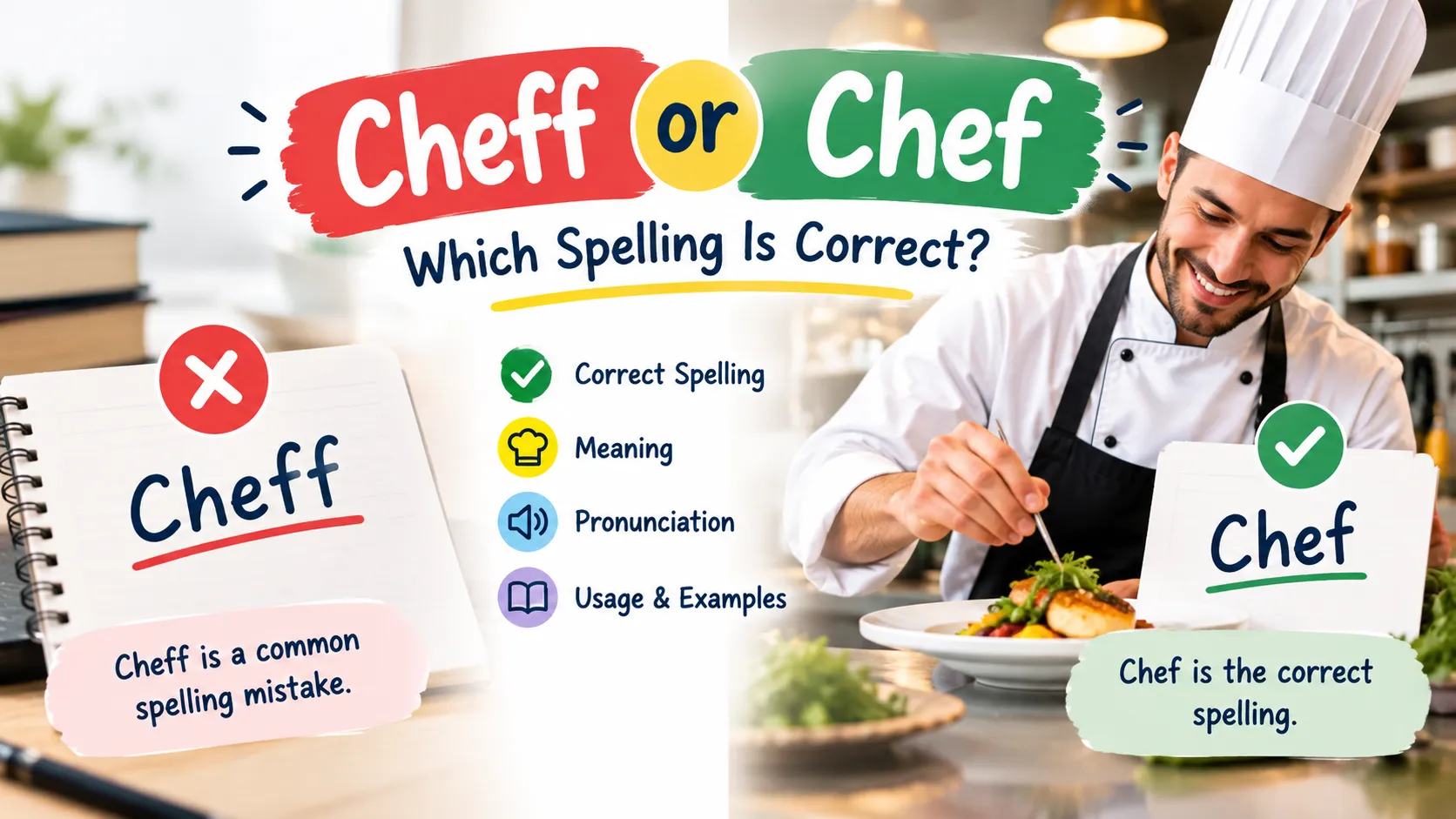
Chef is the correct spelling. “Cheff” is a common spelling mistake.
Cheff or Chef can be confusing when you write about a person who cooks food in a restaurant. You may type, “My brother is a cheff.” However, chef is the correct spelling. You should write, “My brother is a chef.” A chef is a person who cooks and prepares food.
The word chef means a person who cooks food as a job. A chef may work in a restaurant, hotel, school, or other place where food is made. The word cheff is not the standard spelling of this word.
People search for cheff or chef because the word can sound like it has a double f. This can make the spelling confusing. Some people may also write “cheff” because many English words use double letters.
Knowing the difference between cheff or chef can help you avoid spelling mistakes. This is useful for students, writers, food bloggers, job seekers, and English learners.
In this guide, you will learn the correct spelling, meaning, pronunciation, usage, history, common mistakes, and simple examples.
Pronunciation
Chef
- US: /ʃef/
- UK: /ʃef/
The word chef has one syllable. It sounds like “shef.”
Cheff
Cheff is not the standard spelling of the word. It is usually a spelling mistake for chef, so it has no separate standard English pronunciation as a job title.
The correct word is chef.
Transition
Now, let us look at the main differences between cheff or chef.
Difference Between Cheff and Chef
1. Correct Spelling
Chef is the correct spelling.
Cheff is not the standard spelling.
Examples:
- “She is a chef.”
- “The chef made a fresh meal.”
Do not write:
- “She is a cheff.”
- “The cheff made a fresh meal.”
2. Meaning
Chef means a person who cooks food as a job.
Cheff has no standard meaning as the correct spelling of this word.
Examples:
- “The chef works in a hotel.”
- “The chef prepared dinner.”
3. Number of Letters
The word chef has four letters.
The word cheff has five letters because it has two f letters.
Examples:
- Correct: “chef”
- Incorrect: “cheff”
4. Use in Writing
Use chef in school work, blogs, menus, emails, and other writing.
Do not use cheff when you mean a professional cook.
Examples:
- “The chef cooked a large meal.”
- “I want to become a chef.”
5. Use in Job Titles
Chef can be part of a job title.
For example:
- “She is a head chef.”
- “He works as a pastry chef.”
Cheff should not be used in these job titles.
6. Use in a Restaurant
Restaurants often use the word chef when talking about their cooking staff.
Examples:
- “The chef prepared the special dish.”
- “Ask the chef about today’s menu.”
The spelling cheff is incorrect in these sentences.
7. Use in School
Students may use chef when writing about jobs or careers.
Examples:
- “My dream job is to become a chef.”
- “A chef prepares food for people.”
Writing cheff in a school assignment would be a spelling error.
8. Use in a Resume
A person applying for a cooking job should use chef.
Examples:
- “Worked as a chef for three years.”
- “Experienced chef with cooking skills.”
Using cheff may make a resume look less professional.
9. Use in Food Articles
Food writers and bloggers use chef when talking about professional cooks.
Examples:
- “The chef shared his recipe.”
- “The chef opened a new restaurant.”
Always use chef, not cheff.
10. Use in Online Searches
Search engines and websites normally use chef for the profession.
Examples:
- “Best chef recipes”
- “How to become a chef”
If you search for cheff, you may still see results for chef, because “cheff” is often a spelling mistake.
Nature and Behaviour of Cheff and Chef
Chef
Chef is a noun. It names a person who cooks food as a profession.
It can be used for different types of cooking jobs.
Examples include:
- head chef
- pastry chef
- private chef
- sous chef
- executive chef
Example sentences:
- “The chef made a chocolate cake.”
- “The chef works at a busy restaurant.”
Cheff
Cheff is not the standard English spelling for this job.
It is usually a spelling mistake.
For example:
- Incorrect: “He is a cheff.”
- Correct: “He is a chef.”
Why People Get Confused About Cheff or Chef
People often confuse these spellings because chef sounds like it may have two f letters.
English has many words with double letters. For example:
- coffee
- happy
- dinner
- letter
Because of this, some learners may think cheff looks right.
However, chef has only one f.
Another reason for confusion is the French origin of the word. English does not always spell borrowed words in the way learners expect.
The simple rule is:
Chef = correct.
Cheff = incorrect for the cooking job.
Comparison Table
| Feature | Cheff | Chef |
|---|---|---|
| Correct spelling | No | Yes |
| Meaning | No standard meaning | Professional cook |
| Letters | 5 | 4 |
| Part of speech | Not standard | Noun |
| Used for a job | No | Yes |
| Used in resumes | No | Yes |
| Used in restaurants | No | Yes |
| Used in school work | No | Yes |
| Used in food writing | No | Yes |
| Standard English word | No | Yes |
The main difference is simple: chef is correct, while cheff is a spelling mistake.
The Origin of Chef
The word chef comes from French.
The French word chef means “chief” or “head.” It is linked to the idea of a person who is in charge.
In French, chef de cuisine means the head of a kitchen.
English later used chef to mean a professional cook, especially a skilled cook who works in a professional kitchen.
The spelling stayed as chef.
This is why English uses chef, not cheff.
The word became common in English as French food and cooking terms became more widely used.
British vs American English
There is no major spelling difference between British and American English for this word.
Both use:
chef
British English
- “She is a chef.”
- “The chef works in a London restaurant.”
American English
- “She is a chef.”
- “The chef works in a New York restaurant.”
The spelling is the same in both forms of English.
Cheff is not the standard spelling in either British or American English.
Spelling Rule
Use:
chef
Do not use:
cheff
Which One Should You Use?
Always use chef when you mean a professional cook.
For US English
Use chef.
Example:
- “My sister wants to become a chef.”
For UK English
Use chef.
Example:
- “He works as a chef in a hotel.”
For Global English
Use chef.
It is easy to understand around the world.
The simple rule is:
Chef is correct in US English, UK English, and global English.
Also read more about https://textlinkerpro.com/peon-or-pion/
Common Mistakes
Mistake 1: Adding a Second F
Incorrect:
- “She is a cheff.”
Correct:
- “She is a chef.”
Mistake 2: Using Cheff in a Job Title
Incorrect:
- “He is a head cheff.”
Correct:
- “He is a head chef.”
Mistake 3: Using Cheff in a Resume
Incorrect:
- “I worked as a cheff.”
Correct:
- “I worked as a chef.”
Mistake 4: Using Cheff in a Blog
Incorrect:
- “The cheff shared a new recipe.”
Correct:
- “The chef shared a new recipe.”
Mistake 5: Using Cheff in School Work
Incorrect:
- “A cheff cooks food.”
Correct:
- “A chef cooks food.”
Everyday Usage Examples
In Emails
Correct:
“Hello,
I would like to ask about the chef’s special menu.”
On Social Media
Correct:
“Today, the chef made an amazing cake!”
In News
Correct:
“The famous chef opened a new restaurant.”
In Formal Writing
Correct:
“A chef is a trained professional who prepares food.”
In Daily Conversation
Correct:
“My uncle is a chef.”
These examples all use chef.
Usage Trends
The word chef is widely used in modern English.
It appears in:
- Restaurant menus
- Food blogs
- Cooking shows
- News articles
- Job listings
- School books
- Social media
- Recipes
The word is also common in job titles.
Examples include:
- chef
- head chef
- pastry chef
- private chef
- sous chef
The spelling cheff may appear online because people make spelling mistakes. However, it is not the standard spelling.
For clear and correct writing, always choose chef.
Metaphors and Similes
The word chef is mainly used in its real meaning. However, it can also be used in creative comparisons.
Like a Chef
We can say someone works like a chef when they are very good at making or creating something.
Example:
- “She mixes colors like a chef mixes ingredients.”
Cooking Up an Idea
The word cook can be used in a figurative way.
Example:
- “The team is cooking up a new idea.”
This means the team is creating a new idea.
A Recipe for Success
A recipe can also describe a good plan.
Example:
- “Hard work and patience are a recipe for success.”
These examples use cooking words in a creative way.
Connotative Meaning
Chef — Positive Meaning
The word chef often has a positive meaning.
It can suggest:
- Skill
- Talent
- Hard work
- Creativity
- Professional work
Example:
- “The chef is known for creative dishes.”
Chef — Neutral Meaning
The word can simply name a person’s job.
Example:
- “My brother is a chef.”
There is no strong feeling in this sentence.
Chef — Negative Meaning
The word chef itself is not usually negative. A negative meaning may come from the situation.
Example:
- “The chef made a poor meal.”
The negative feeling comes from the poor meal, not from the word chef.
Cheff
Cheff usually has a negative effect in writing because it is a spelling mistake.
Example:
- “He works as a cheff.”
The problem is the spelling. The correct form is chef.
Idioms and Proverbs
There is no common idiom that means exactly chef.
However, English has many food-related phrases.
Too Many Cooks Spoil the Broth
This means too many people trying to control one task can cause problems.
Example:
- “Everyone wanted to change the plan. Too many cooks spoil the broth.”
A Recipe for Success
This means a good mix of things that can lead to success.
Example:
- “Hard work and patience are a recipe for success.”
If You Can’t Stand the Heat, Get Out of the Kitchen
This means that if you cannot handle pressure, you should leave a difficult situation.
Example:
- “The job is very stressful. If you can’t stand the heat, get out of the kitchen.”
Literature and Movies
Chefs and professional cooking appear in many books and films.
Literature
The Restaurant at the End of the Universe by Douglas Adams was published in 1980. It is a science fiction comedy novel. It includes a famous restaurant setting and uses food in a creative way.
Movie
Ratatouille was released in 2007. It is an American animated film. The story focuses on cooking, food, and a young rat who dreams of becoming a great chef.
The film helped make the word chef familiar to many young English learners.
Why This Difference Matters
Knowing the correct spelling of chef is important for clear English.
A spelling mistake can make your writing look less professional. This matters in school work, resumes, websites, menus, blogs, and business writing.
For example, if you are applying for a cooking job, writing cheff on your resume may look careless.
Using chef shows that you know the correct English spelling.
This small spelling difference can help students and English learners write with more confidence.
It also helps readers understand your meaning quickly.
The rule is very easy:
Use chef. Do not use cheff for a professional cook.
Usefulness in Daily Life
The word chef can be useful in many daily situations.
You may use it when:
- Talking about restaurant workers
- Writing a food review
- Reading a menu
- Writing a recipe
- Talking about a cooking show
- Applying for a cooking job
- Writing a school assignment
- Writing a food blog
Examples:
- “The chef made fresh pasta.”
- “I want to become a chef.”
- “The restaurant has a new chef.”
- “The chef created a new dish.”
Using the correct spelling makes your writing clear.
Situational Preference
Use chef in every situation when you mean a professional cook. It is the correct spelling in school work, emails, resumes, restaurant menus, blogs, news, and daily conversation. Use chef in both British and American English. Do not choose cheff because it is not the standard spelling of the job title. If you are writing about a person who cooks food as a profession, chef is always the safe choice. This simple rule can help students, writers, job seekers, and English learners avoid a common spelling mistake.
Possible Question
Is cheff or chef correct?
Chef is correct. Cheff is a spelling mistake.
Why do people spell chef as cheff?
People may add a second f because the word sounds like it could have double letters.
How do you spell chef?
The correct spelling is chef.
What does chef mean?
A chef is a person who cooks food as a profession.
Is chef the same in British and American English?
Yes. Both British and American English use chef.
Is cheff a word?
Cheff is not the standard spelling for a professional cook. Use chef instead.
How do you pronounce chef?
Chef is pronounced /ʃef/ in both standard US and UK English.
Conclusion
Cheff or chef can be confusing, but chef is the correct spelling. Cheff is a common spelling mistake. A chef is a person who cooks and prepares food, often in a restaurant or kitchen. The word chef is used in both British and American English. If you are writing about a professional cook, always use chef, not cheff. Remembering this simple rule can help you avoid spelling mistakes in school, work, and daily writing.

I’m Khadija Zafar, a content writer and blogger. I write simple, engaging articles on English grammar, word meanings, synonyms, antonyms, and vocabulary to help readers improve their English skills.









1 thought on “Cheff or Chef: Which Spelling Is Correct?”