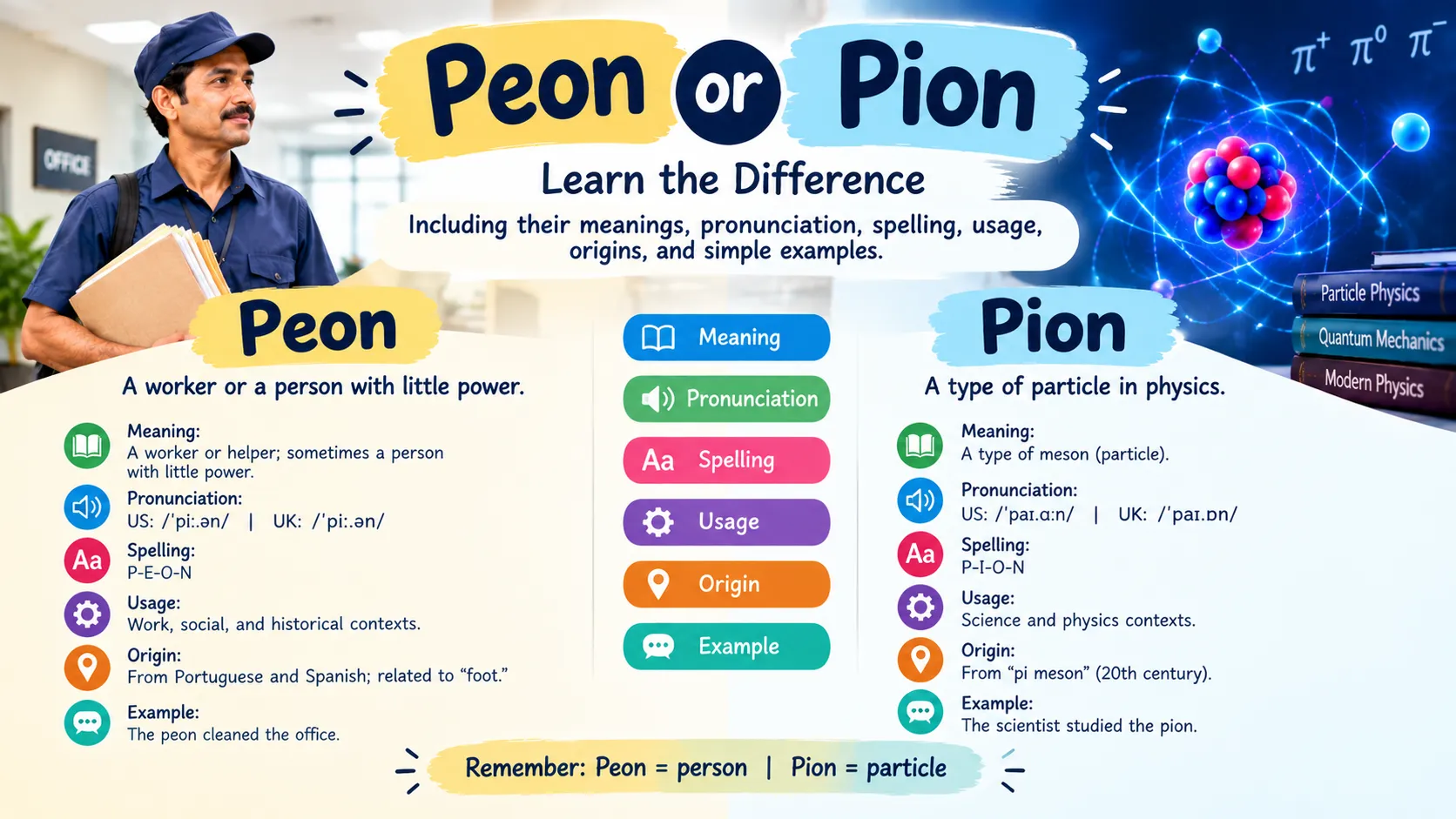
Peon is a worker or a person with little power, while pion is a small particle in physics.
Imagine you are writing an article about an office worker. You type pion, but you are not sure if it is correct. You may wonder, “Should I use peon or pion?” These words look very similar, but they have very different meanings.
Peon is a noun. It can mean a worker who does simple or low-level work. It can also mean a person with little power. In some places, such as South Asia, it has also been used for an office helper or attendant.
Pion is a science word. It is a type of meson, a small particle studied in physics. It is also called a pi meson.
People search for peon or pion because the two words look and sound close. This can cause spelling mistakes. Knowing the difference helps you choose the right word in school, work, science, and daily writing.
Pronunciation
Peon
- US: /ˈpiː.ən/ or /ˈpiː.ɑːn/
- UK: /ˈpiː.ən/ or /ˈpiː.ɒn/
Pion
- US: /ˈpaɪ.ɑːn/
- UK: /ˈpaɪ.ɒn/
Now, let us look at the main differences between these two words.
Difference Between Peon or Pion
1. Meaning
Peon means a worker or a person with little power.
Pion is a type of particle in physics.
Examples:
- The peon cleaned the office.
- He was treated like a peon at work.
- Scientists studied the pion.
- The pion is a type of meson.
2. Field of Use
Peon is mostly used in work, social, and historical contexts.
Pion is used in physics and science.
Examples:
- The peon helped the workers.
- He did many simple tasks as a peon.
- The scientist found a pion.
- The book explains pion decay.
3. Part of Speech
Both peon and pion are nouns.
A noun names a person, thing, or idea.
Examples:
- The peon carried the boxes.
- The pion has a very short life.
4. Type of Person or Thing
A peon is a person.
A pion is not a person. It is a particle.
Examples:
- The peon worked in the office.
- The pion was studied in a lab.
5. Use in Work
Peon can describe a low-level worker or helper.
Pion has no normal work-related meaning.
Examples:
- The peon brought the files.
- He started work as a peon.
6. Use in Science
Pion is a science word.
Peon is not a physics word.
Examples:
- The team studied the pion.
- Pions are important in particle physics.
7. Spelling
The two words differ by one letter.
- Peon: P-E-O-N
- Pion: P-I-O-N
The vowel after P changes the word.
Examples:
- The worker was called a peon.
- The scientist studied a pion.
8. Pronunciation
The words do not sound the same.
Peon starts with a long ee sound.
Pion starts with the sound in pie.
Examples:
- Peon has a sound like “pee.”
- Pion starts with a sound like “pie.”
9. Meaning in Society
Peon can sometimes sound negative because it may suggest low status or little power.
Pion has no social meaning. It is a scientific term.
Examples:
- He did not want to be seen as a peon.
- The researcher measured the pion.
10. Correct Context
Use peon when you are talking about a worker or a person with little power.
Use pion when you are talking about particle physics.
Examples:
- The peon worked in the old office.
- The physicist wrote about the pion.
Nature and Behaviour of Peon or Pion
Nature of Peon
A peon is a person. The word often describes a worker with simple duties or little authority. In some uses, it can sound rude or old-fashioned. Oxford also notes a North American humorous use for a person with a hard, boring, and low-paid job.
Example:
- He felt like a peon in the large company.
Nature of Pion
A pion is a particle studied in physics. There are positive, negative, and neutral pions. A pion is also called a pi meson.
Example:
- The students learned about pions in physics class.
Why People Get Confused About Peon or Pion
People often confuse these words because they have the same number of letters.
They also look almost the same:
- Peon
- Pion
Only one vowel changes.
The meanings are very different, however. Peon is about a person or worker. Pion is about physics.
A simple way to remember them is:
Peon = person.
Pion = particle.
Comparison Table
| Feature | Peon | Pion |
|---|---|---|
| Part of speech | Noun | Noun |
| Main meaning | Worker or low-level person | Type of particle |
| Field | Work and society | Physics |
| Refers to | Person | Particle |
| Spelling | P-E-O-N | P-I-O-N |
| Common use | Work and social writing | Science writing |
| Meaning can be negative | Yes | No |
| Scientific word | No | Yes |
| Plural | Peons | Pions |
| Example | He was a peon. | The pion was studied. |
The Origin of the Keyword
Origin of Peon
The word peon has a long history. It came into English through Portuguese and Spanish forms linked to a person who walks, a foot soldier, or a day laborer. The deeper root is related to the Latin word for foot.
The word later gained meanings linked to workers and people with low social power.
Origin of Pion
The word pion is much newer. It comes from pi meson. The word was formed from pi and the ending -on. It became a scientific term in the 20th century.
So, the two words have different histories.
Also read more about https://textlinkerpro.com/informal-and-formal/
British vs American English
There is no major spelling difference between British and American English.
Both use:
- peon
- pion
The pronunciation of peon can vary slightly. Pion also has a small US and UK pronunciation difference.
British example:
- The office had a peon to help with simple tasks.
American example:
- The scientist studied a pion.
The important point is the meaning, not the spelling style.
Which One Should You Use?
Choose peon when you mean a worker or a person with little power.
The correct word for a physics particle is pion.
In US English, peon means a worker, while pion is a science term.
UK English uses the same spellings and meanings.
For global writing, context helps you choose the right word. Work-related writing may need peon. Physics writing needs pion.
Common Mistakes
Here are some common mistakes:
- Wrong: The scientist studied the peon.
- Correct: The scientist studied the pion.
- Wrong: The pion cleaned the office.
- Correct: The peon cleaned the office.
- Wrong: He worked as a pion.
- Correct: He worked as a peon.
- Wrong: The worker was a pion.
- Correct: The worker was a peon.
- Wrong: The physics book explains the peon.
- Correct: The physics book explains the pion.
Everyday Usage Examples
In Emails
- The peon brought the documents.
- Please ask the office peon for help.
On Social Media
- I started at the bottom and worked hard.
- Nobody should treat a worker like a peon.
In News
- The report discussed the lives of low-level workers.
- Scientists reported new findings about pions.
In Formal Writing
- The term peon has a long social and historical use.
- The pion is studied in particle physics.
Usage Trends
Peon is still used in English, but its use depends on the country and context. It may describe a low-level worker. In South Asian English, it has also been used for an office helper or attendant.
Pion is mainly used in science. It is common in books, research papers, and physics classes.
These words are not true synonyms. They belong to very different areas of language.
Metaphors and Similes
Peon can be used in a figurative way.
For example:
- “He felt like a peon in the company.”
- “She did not want to be treated like a peon.”
These sentences show low status or little power.
Pion is not commonly used as a metaphor in everyday English.
In science writing, it keeps its direct meaning as a particle.
Connotative Meaning
Connotation means the feeling or idea that a word can give.
Peon — Negative
Peon can have a negative meaning when it suggests low status, little power, or boring work.
Example:
- He felt like a peon in the company.
Peon — Neutral
In some work or historical contexts, peon can be a simple job title or description.
Example:
- The story describes a farm peon.
Pion — Neutral
Pion is normally neutral. It is a scientific term.
Example:
- The students studied the pion in physics class.
Idioms and Proverbs
There are no common famous idioms or proverbs built around pion.
There are also no major standard English proverbs that use peon.
However, peon can appear in simple figurative phrases.
Examples:
- He was treated like a peon.
- She did not want to feel like a peon.
These phrases show low status or little power.
Literature and Movies
The word peon appears in literature, especially in stories about work, class, power, and social life.
For example, Manju Kapur’s novel The Gallery (2023), a work of contemporary fiction, includes an office peon as part of its story about two families and social class.
The word also appears in Red Rising by Pierce Brown, a dystopian science-fiction novel published in 2014. The author describes his own earlier work experience as a peon in the entertainment industry.
The word pion is more common in science books and science films than in normal fiction. It is used when a story discusses particle physics.
Why This Difference Matters
Knowing the difference between peon or pion helps you avoid spelling and meaning errors.
A small letter can change the whole meaning.
If you use pion when you mean a worker, your sentence will be wrong.
If you use peon when you mean a physics particle, your sentence will also be wrong.
This difference is important for students, writers, teachers, and science learners. It is also useful for people who write emails, reports, blogs, and school work.
A simple rule can help:
Peon = worker or person.
Pion = particle.
Usefulness in Daily Life
You may see peon in older texts, history, social writing, or some workplace settings.
You are more likely to see pion in:
- Physics books
- Science classes
- Research papers
- Science news
- Educational websites
Knowing the meaning helps you understand what you read.
It also helps you choose the correct spelling when writing.
Situational Preference
Use peon when you are talking about a worker, helper, or person with little power. It may sound old-fashioned or negative in some settings, so use it with care. In modern writing, worker, assistant, or employee may be better. Use pion only when you are talking about particle physics. It is the correct word for a type of meson. If you are writing for school, work, or a blog, always check the meaning before choosing the word. The simple rule is easy: peon is a person, while pion is a particle.
Possible Question
Is peon the same as pion?
No. Peon means a worker or a person with little power. Pion is a particle in physics.
Is peon a correct English word?
Yes. Peon is a correct English word. It has several historical and modern uses.
Is pion a correct English word?
Yes. Pion is a correct scientific word. It means a type of meson.
How do you spell peon?
The correct spelling is P-E-O-N.
How do you spell pion?
The correct spelling is P-I-O-N.
What does peon mean in an office?
In some varieties of English, especially South Asian English, peon has been used for an office helper or attendant.
What is a pion in physics?
A pion is a type of meson. It can have a positive, negative, or neutral charge.
Conclusion
Peon or pion look very similar, but they have completely different meanings. Peon is a word for a worker or a person with little power. In some places, it has also been used for an office helper or attendant. Pion, on the other hand, is a scientific word. It means a type of meson studied in particle physics. The easiest way to remember the difference is simple: peon is a person, while pion is a particle. Use peon when talking about work, workers, or social status. Use pion when talking about physics and science. Both words are correct, but they belong to different contexts. Knowing this small spelling difference can help students, writers, and English learners avoid mistakes and write with more confidence.

I’m Khadija Zafar, a content writer and blogger. I write simple, engaging articles on English grammar, word meanings, synonyms, antonyms, and vocabulary to help readers improve their English skills.









1 thought on “Peon or Pion: What Is the Difference?”