SPY or QQQ is a common question for people who want to invest in the stock market. Both are exchange-traded funds, also called ETFs. They let people buy many stocks through one fund. However, they follow different groups of stocks.
SPY follows the S&P 500 Index. This index tracks about 500 large US companies. QQQ follows the Nasdaq-100 Index. This index tracks 100 of the largest non-financial companies listed on the Nasdaq market.
Imagine you want to buy a small part of many companies. You could buy each stock one by one, but that may take time and money. An ETF can make this task easier. You buy one fund, and it gives you access to many stocks.
SPY and QQQ are both popular choices, but they are not the same. SPY gives you a wider mix of large US companies. QQQ has more focus on tech and growth companies. This can affect how each fund moves when stock prices rise or fall.
How to Say SPY and QQQ
SPY is said like the word “spy.” It has one syllable.
QQQ is often said by reading each letter: “Q-Q-Q.” It has three spoken letter names.
Both names are stock market symbols, also called ticker symbols. They help people find funds on a trading app or website.
Difference Between SPY or QQQ
SPY and QQQ both let people invest in many stocks at once. But they track different indexes and can give different results.
1. The Index They Follow
SPY follows the S&P 500 Index. This index includes many large US companies from different parts of the economy.
QQQ follows the Nasdaq-100 Index. It includes 100 large non-financial companies listed on the Nasdaq market.
Example:
- SPY gives you access to a broad group of large US companies.
- QQQ gives you access to a smaller group of large Nasdaq-listed companies.
2. The Types of Companies
SPY has stocks from many fields. These can include health care, banks, tech, energy, and shops.
QQQ has a strong focus on tech and other growth-based companies. It also holds companies from other fields.
Example:
- SPY may suit someone who wants a broad mix of large US stocks.
- QQQ may suit someone who wants more exposure to large growth and tech firms.
3. Risk Level
Both funds carry risk. Their prices can go down when the stock market falls.
SPY spreads its money across a wider mix of large companies. QQQ can be more affected by changes in tech and growth stocks.
Example:
- If tech stocks fall, QQQ may feel a strong effect.
- If many types of large US stocks fall, SPY may also lose value.
Neither fund is risk-free. You can lose money with either one.
4. Price Changes
SPY and QQQ do not always rise or fall by the same amount. Their results depend on the stocks they hold.
QQQ may rise more during times when its main growth stocks do well. It may also fall more when those stocks face trouble.
SPY can move in a different way because it holds a broader mix of large companies.
Example:
- A strong rise in tech stocks may help QQQ.
- A strong rise across many parts of the US market may help SPY.
Past results do not tell you what will happen next.
5. Fees
ETFs charge fees to cover the cost of running the fund. These fees are often called expense ratios.
SPY and QQQ have different fees. Check the latest fee on each fund’s official website before you invest. Even a small fee can add up over many years.
Example:
- A lower fee can leave more of your money invested.
- A higher fee may cost more over time.
Do not choose a fund based on fees alone. Also look at its holdings, risk, and your own goals.
6. Number of Stocks
SPY tracks an index of about 500 large US companies. QQQ tracks an index of 100 large non-financial Nasdaq-listed companies.
Having more stocks does not always mean a fund is safer. The type and size of each holding also matter.
Example:
- SPY gives you access to a larger number of companies.
- QQQ gives you access to a smaller group that has a stronger growth and tech focus.
7. Long-Term Use
Some people buy ETFs and hold them for many years. Others trade them more often.
Both SPY and QQQ can be used for long-term investing, but they have different risks. Your choice should match your plan and your ability to handle losses.
Example:
- A person who wants broad US market exposure may study SPY.
- A person who wants more exposure to growth stocks may study QQQ.
Always check your full plan before buying.
8. Dividends
Some companies pay part of their profits to their stock owners. These payments are called dividends.
SPY and QQQ can both pay dividends because they hold stocks that may make these payments. The amount can change over time.
Example:
- An investor may receive dividend payments from an ETF.
- The payment may rise or fall as the fund’s holdings change.
Nature and Behaviour of SPY and QQQ
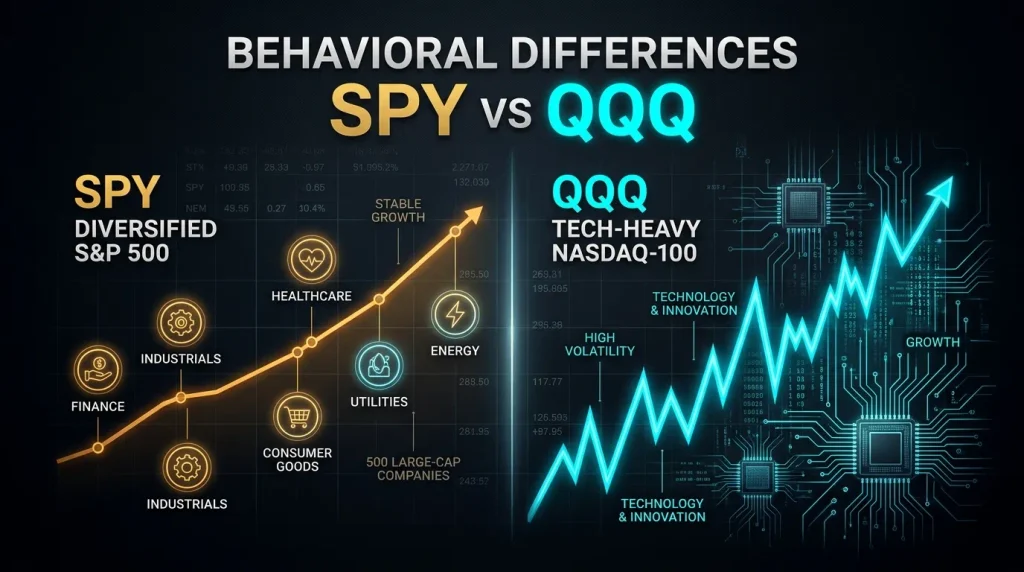
SPY and QQQ both follow groups of stocks, but they can behave in different ways.
SPY has a broad mix of large US companies. This can give investors access to several parts of the economy through one fund. It does not mean SPY will always have small losses when the market falls.
QQQ has a greater focus on large growth and tech firms. These companies can grow fast, but their stock prices can also change quickly. This may make QQQ more sensitive to changes in tech stock prices.
Think about two baskets. One basket holds fruit from many kinds of trees. The other holds fruit from fewer kinds of trees. If one type of fruit has a bad season, the second basket may feel a bigger effect.
This is only a simple example. Real stock prices depend on many things, such as company profits, interest rates, and news.
Why People Get Confused About SPY or QQQ
People often compare SPY and QQQ because both are popular ETFs. They trade on the stock market, and both let people invest in many companies at once.
Their names can also cause confusion. SPY and QQQ are short ticker symbols, not the names of single companies.
Another reason for confusion is that both funds can rise when the stock market does well. But they do not track the same index. Their returns can be different.
Some people think QQQ is always better because it may do well when tech stocks rise. Others think SPY is always better because it follows a broader index. Neither idea is always true.
The right choice depends on what you want from your investment. It also depends on the level of risk you can accept.
Also read more about https://textlinkerpro.com/hurts-or-stafford/
Quick Comparison Table
| Feature | SPY | QQQ |
|---|---|---|
| Full fund name | SPDR S&P 500 ETF Trust | Invesco QQQ Trust |
| Index | S&P 500 | Nasdaq-100 |
| Main focus | Large US companies | Large Nasdaq-listed non-financial companies |
| Tech focus | Broad mix of sectors | Stronger tech and growth focus |
| Number of index stocks | About 500 | 100 |
| Risk | Has market risk | Has market and sector risk |
| Fees | Check current fee | Check current fee |
| Best use | Broad US stock exposure | More growth and tech exposure |
This table gives a simple view of the main differences. Always check current fund details before making a choice.
Where Do the Names SPY and QQQ Come From?
SPY and QQQ are ticker symbols. A ticker symbol is a short code used to find a fund or stock on the market.
SPY is linked to the SPDR S&P 500 ETF Trust. It aims to follow the S&P 500 Index.
QQQ is linked to the Invesco QQQ Trust. It aims to follow the Nasdaq-100 Index.
These names are used in trading apps, market reports, and finance websites. They help people find the right fund quickly.
SPY or QQQ in the US and UK
SPY and QQQ are US-listed funds. People in the US may be able to buy them through a stock broker that offers these funds.
People in the UK may face different rules. Their access can depend on the broker, account type, and local laws. Some funds may not be available to all UK retail investors.
Tax rules can also differ by country. Before buying a US-listed ETF, check the rules that apply to you.
Do not assume that a fund is open to every investor in every country. Ask a licensed adviser or broker if you need help.
Which One Should You Choose?
The choice between SPY or QQQ depends on your needs.
SPY may be worth studying if you want exposure to a broad group of large US companies. Its index covers many parts of the US stock market.
QQQ may be worth studying if you want more exposure to large growth and tech firms. You should also be ready for price changes linked to those sectors.
Before you buy either fund, ask yourself three questions:
- What is my goal?
- How much money can I afford to lose?
- How long do I plan to keep my money invested?
Also check the fees, fund holdings, and latest fund details. Do not choose only because a friend owns it or because it did well last year.
Common Mistakes to Avoid
Many new investors make simple mistakes when they compare SPY and QQQ.
Mistake 1: Thinking one fund is always better. Both funds have good and bad periods. Their future results are not certain.
Mistake 2: Looking only at past returns. A fund that did well last year may not do well next year.
Mistake 3: Ignoring fees. Fees can lower your returns over time, so check them before buying.
Mistake 4: Forgetting about risk. Stock prices can fall. Never invest money that you may need soon without thinking carefully about the risk.
Mistake 5: Buying without a plan. Know why you want to invest and how long you plan to stay invested.
Simple Examples of SPY or QQQ
Here are two easy examples.
Example 1: Sara wants to invest in a broad group of large US companies. She reads about the S&P 500 and studies SPY. She checks its fees and risks before making a choice.
Example 2: Ali wants more exposure to large tech and growth firms. He studies QQQ and checks which companies it holds. He also learns that the fund can fall when those stocks lose value.
These examples do not mean SPY is right for Sara or QQQ is right for Ali. Each person must look at their own needs, goals, and risk level.
How to Learn More About These Funds

You can learn more by reading the official fund pages. Check which index each fund follows, what it holds, and what fees it charges.
You can also compare past results. Remember that past results do not promise future gains. Look at how each fund acted during both strong and weak markets.
It may help to write down your goals before you invest. Keep your plan simple and review it when your needs change.
Avoid making choices based only on social media posts or claims of quick profit. No ETF can promise that you will make money.
Possible Questions
1. What is the main difference between SPY and QQQ?
SPY follows the S&P 500 Index, which tracks about 500 large US companies. QQQ follows the Nasdaq-100 Index, which tracks 100 large non-financial Nasdaq-listed companies.
2. Is SPY safer than QQQ?
SPY has a broader mix of companies, while QQQ has more focus on tech and growth stocks. Both can lose money. The risk depends on market conditions and your own needs.
3. Can I hold SPY and QQQ together?
Some investors hold both funds. However, they may own some of the same companies through each fund. Check their holdings so you understand how much overlap you have.
4. Do SPY and QQQ pay dividends?
Both funds may pay dividends. The amount and timing can change. Check the latest fund information for current details.
5. Which fund has lower fees?
The fees are different and can change. Check the official SPY and QQQ fund pages for the latest expense ratios.
6. Can I lose money with SPY or QQQ?
Yes. Both funds can fall in value when their stocks fall. You may get back less money than you invested.
7. Are SPY and QQQ single stocks?
No. They are ETFs. Each one gives you access to a group of stocks through one fund.
Conclusion
SPY or QQQ is a choice between two popular stock market funds. SPY follows the S&P 500 and gives access to a broad mix of large US companies. QQQ follows the Nasdaq-100 and has more focus on large growth and tech firm. Both funds can help people invest in many stocks at once. But both also carry risk. Their prices can rise or fall, and neither one promises profit. Before you choose, think about your goal, how long you want to invest, and how much risk you can accept. Check the latest fees and holdings, too. Do not pick a fund only because it did well in the past .The best fund is not the same for every person. Learn how each one works, make a clear plan, and seek expert help if you need it.

I’m Khadija Zafar, a content writer and blogger. I write simple, engaging articles on English grammar, word meanings, synonyms, antonyms, and vocabulary to help readers improve their English skills.