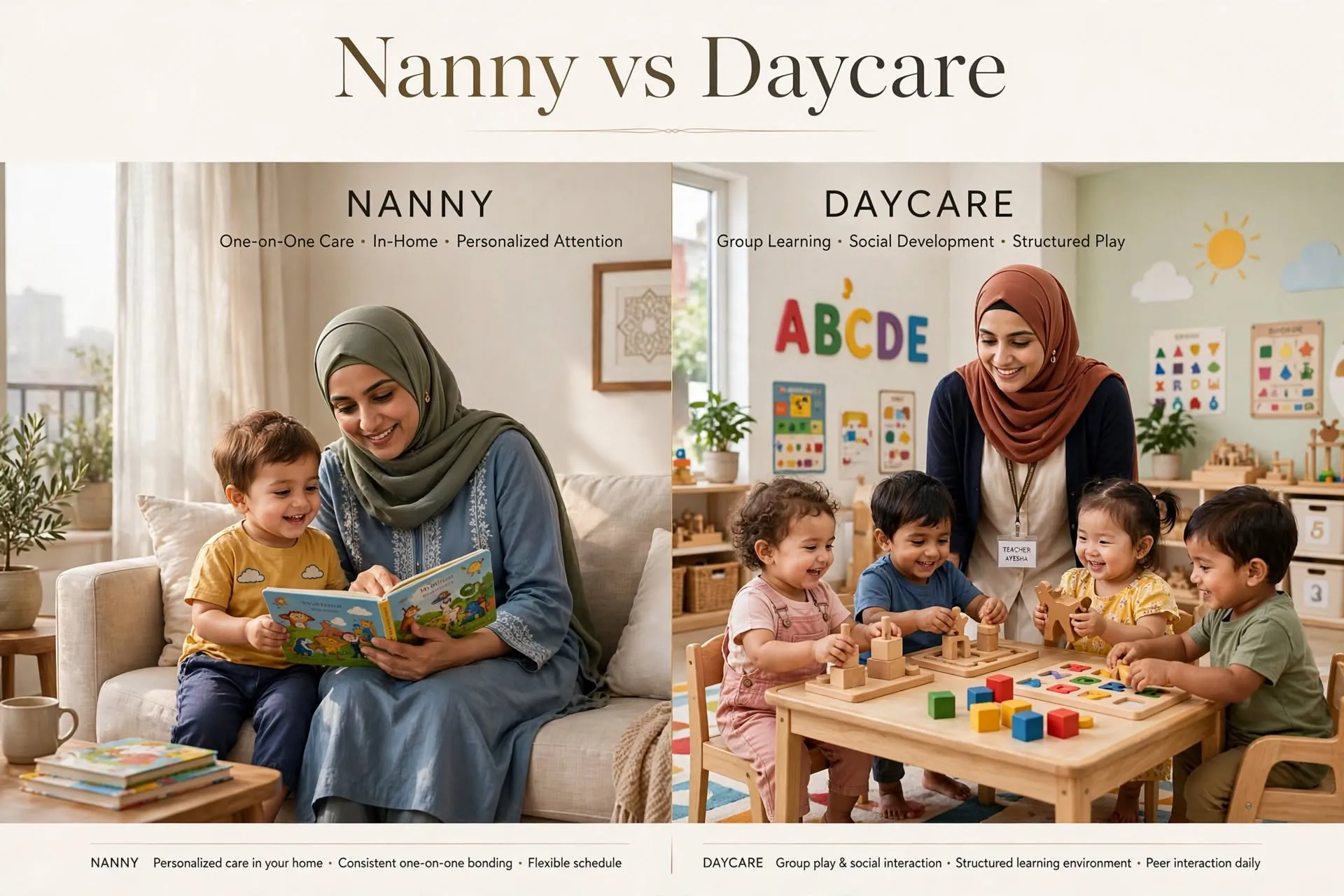
A nanny cares for your child at home, while daycare cares for children in a group setting.
Imagine you are going back to work after having a baby. You need someone to care for your child while you are away. You may think about hiring a nanny or choosing a daycare center. Both options can help, but they work in different ways.
A nanny is a person who looks after children. A nanny often works in the child’s home. The job may include feeding, playing, and helping with naps. Daycare is a service that cares for children during the day. It often takes place in a center or a home-based setting.
Parents search for nanny or daycare because they want to know which choice is safer, cheaper, and better for their child. Some parents want care at home. Others want their children to play with others.
The best choice depends on your child’s age, your budget, and your daily plans. Knowing the main differences can help you choose the right care for your family.
Pronunciation
Nanny
- US: /ˈnæni/
- UK: /ˈnæni/
Daycare
- US: /ˈdeɪˌker/
- UK: /ˈdeɪkeə/
Let’s look at the main differences between these two options.
Difference Between Nanny and Daycare
1. Place of Care
A nanny usually cares for a child at home. Daycare takes place in a center or another care setting.
Examples:
- A nanny looks after Mia at home.
- Ben goes to daycare each morning.
2. Personal Attention
A nanny may give a child more personal attention. Daycare staff care for several children at once.
Examples:
- A nanny reads a story to one child.
- A daycare worker helps a group with a game.
3. Cost
A nanny may cost more, especially for full-time care. Daycare may cost less per child.
Examples:
- A family pays a nanny to work all day.
- Parents choose daycare to save money.
4. Social Skills
Daycare gives children more chances to play with others. A nanny can also plan playdates.
Examples:
- Lily learns to share toys at daycare.
- Noah plays with other children at a park.
5. Daily Routine
A nanny may follow your child’s usual routine. Daycare often has set times for meals, naps, and play.
Examples:
- A nanny helps a baby nap at the usual time.
- Children eat lunch together at daycare.
6. Working Hours
A nanny may offer flexible hours if both sides agree. Daycare usually has set opening times.
Examples:
- A nanny stays late after an agreed change.
- A parent picks up a child before daycare closes.
7. Illness
Children in group care may catch common illnesses from others. A nanny can reduce contact with other children, but illness can still spread.
Examples:
- Several children catch a cold at daycare.
- A nanny cares for a child at home.
Parents should check the provider’s rules for sick days.
8. Learning Activities
Daycare may offer songs, games, and group learning. A nanny can plan activities for one child’s needs.
Examples:
- Children sing songs at daycare.
- A nanny helps a child build with blocks.
9. Backup Care
A daycare may have other staff when one worker is away. If a nanny is sick, parents may need another plan.
Examples:
- Another worker helps at the daycare center.
- A relative helps when the nanny is ill.
10. Family Needs
A nanny may suit families who need care at home. Daycare may suit parents who want group play and a set routine.
Examples:
- A nanny cares for two young children at home.
- A child attends daycare near a parent’s work.
Nature and Behaviour of a Nanny and Daycare
Nanny
A nanny is a person who cares for children. The nanny may feed them, help them sleep, plan games, and keep them safe.
A good nanny should be kind, patient, and reliable. Parents should check work history and references. They should also agree on hours, duties, and pay.
Daycare
Daycare is a service that cares for children during the day. Children often follow a daily plan with meals, naps, games, and learning.
A good daycare should have safe rooms, caring staff, and clear rules. Parents should check local rules and visit the center before making a choice.
Why People Get Confused About Nanny or Daycare
People mix up these terms because both provide childcare while parents work.
The main difference is simple. A nanny is a person. Daycare is a service.
Some services may seem alike. A nanny may care for siblings, while a small daycare may run in a private home. Both may offer meals, play, and learning.
Parents should compare safety, staff, costs, and daily routines before choosing.
Comparison Table
| Feature | Nanny | Daycare |
| Meaning | A person who cares for children | A childcare service |
| Place | Usually the family home | Center or home-based setting |
| Attention | Often one-to-one | Shared among children |
| Cost | May cost more | May cost less per child |
| Social time | Playdates may be needed | Group play is common |
| Schedule | May be flexible | Usually set hours |
| Learning | Can fit one child’s needs | Often includes group activities |
| Backup | May be harder to arrange | Other staff may be available |
Both options can help children grow. Parents should compare quality, safety, and cost.
The Origin of Nanny and Daycare
The word nanny has been used in English for a person who cares for children. It is linked to familiar names such as Nan and Anna.
The word daycare joins day and care. It means care given during the day. The term became common as more families needed childcare while parents worked.
Today, the words have different uses. A nanny is a person, while daycare is a service.
Also read more about https://textlinkerpro.com/circulating-nurse/
British vs American English
Both words are understood in the US and the UK. However, people may use different terms for childcare settings.
American English
In the US, daycare is common. People also say “daycare center” or “childcare center.”
Examples:
- My son starts daycare next week.
- We hired a nanny for our baby.
British English
In the UK, nursery or day nursery is often used for a place that cares for young children. “Nanny” is common in the UK, too.
Examples:
- Our daughter goes to nursery every day.
- We need a nanny for our two children.
Which One Should You Use?
- US: Use “nanny” for a person who cares for children at home. Use “daycare” for group care.
- UK: Use “nanny” for home care and “nursery” for many group settings.
- Global readers: Explain the type of care so everyone can understand.
Common Mistakes
- Wrong: A nanny and daycare are the same.
Right: A nanny is a person. Daycare is a service. - Wrong: Every nanny works full-time.
Right: Some nannies work part-time. - Wrong: Daycare is always cheaper.
Right: Costs depend on the place and hours. - Wrong: A nanny cares for only one child.
Right: Some nannies care for siblings. - Wrong: Daycare is always a large center.
Right: Some daycare services run in private homes. - Wrong: One option is always safer.
Right: Safety depends on the staff and setting.
Everyday Usage Examples
In Emails
Nanny: “Hello, I am looking for a nanny for my two-year-old child. Please share your hours and rates.”
Daycare: “Hello, I would like to learn about your daycare fees and open places.”
On Social Media
- “We found a kind nanny for our child.”
- “Our little one had a great first day at daycare!”
In News
- “Many families are looking for trained nannies.”
- “The city plans to add more daycare places.”
In Formal Writing
- “The family hired a nanny to care for their child at home.”
- “The parents chose a daycare center near work.”
Use “nanny” for a person and “daycare” for a service.
Usage Trends
The use of these words can vary by country. In the US, “daycare” is common. In the UK, many parents use “nursery” for group care.
Some families choose a nanny because they want care at home. Others choose daycare because children can play with others.
The best choice depends on the child’s needs, local costs, work hours, and the care available. Parents should compare local services before deciding.
Metaphors and Similes
These words do not have many common figurative meanings. Still, people use simple phrases to describe good childcare.
- A nanny is like an extra pair of caring hands.
Example: “Our nanny helps us on busy days.” - Daycare is like a little learning community.
Example: “The children learn and play together at daycare.” - A trusted nanny is like an anchor.
Example: “Our nanny gives our child a steady daily routine.”
These phrases show how childcare can help a family.
Connotative Meaning
Connotation means the feelings linked to a word. Both terms can have positive, negative, or neutral meanings.
Positive Meaning
A nanny may suggest care and comfort. Daycare may suggest learning and friendship.
Examples:
- “Our nanny makes our child feel safe.”
- “Daycare helps children learn to share.”
Negative Meaning
Some parents may worry about cost or group size.
Examples:
- “A full-time nanny costs too much for us.”
- “I worry that the daycare group is too large.”
Neutral Meaning
Both words can simply name a type of childcare.
Examples:
- “We hired a nanny last month.”
- “Our child attends daycare near home.”
Idioms and Proverbs
No common English idiom refers only to nannies or daycare. However, these sayings fit the topic.
- It takes a village to raise a child.
Children can benefit from help from trusted people.
Example: “Our family and daycare staff help our child. It takes a village to raise a child.” - Better safe than sorry.
It is wise to take steps to avoid harm.
Example: “We checked the nanny’s references because better safe than sorry.” - Actions speak louder than words.
What people do matters more than what they say.
Example: “The daycare staff treat children with care. Actions speak louder than words.”
Literature and Movies
Childcare is a common theme in books and films.
Literature
Mary Poppins is a children’s fantasy novel by P. L. Travers, first published in 1934. It tells the story of a magical nanny who cares for the Banks children.
The Nanny Diaries is a novel by Emma McLaughlin and Nicola Kraus, published in 2002. It follows a young woman who works as a nanny for a wealthy family.
Movies
Mary Poppins (1964, United States) is a musical fantasy film about a magical nanny who helps a family.
The Nanny Diaries (2007, United States) is a comedy-drama film based on the 2002 novel. It shows some of the challenges of working as a nanny.
These stories are fictional. Real childcare can be different.
Why This Difference Matters
Knowing the difference between a nanny and daycare helps parents make better choices. It also helps people use the right words.
A nanny may offer care that fits one family’s routine. Daycare may give children more chances to play and learn in a group. Both options can support children when the care is safe and well planned.
Cost is also important. A nanny’s pay may depend on hours and duties. Daycare fees may depend on the child’s age and location.
Clear words can prevent confusion. A nanny job post should list duties and hours. A daycare listing should explain fees, opening times, and rules.
Usefulness in Daily Life
These words help families plan childcare.
- Working parents: Find care that fits their work hours.
- Parents of babies: Check feeding, sleep, and safety needs.
- Parents of toddlers: Compare home care with group play.
- Families with siblings: See if a nanny can care for both children.
- Parents on a budget: Compare local prices.
- English learners: Use the right word when talking about childcare.
Situational Preference
A nanny may suit families who want care at home, have changing work hours, or have more than one young child. It can also help a child follow a familiar routine. Daycare may suit parents who want group play and set daily activities. It may cost less, but prices vary. Before you choose, compare cost, location, staff, and safety rules. Visit the daycare or meet the nanny first. Ask questions and check references. The best option is the one that meets your child’s needs and works for your family.
Possible Question
1. What is the main difference between a nanny and daycare?
A nanny is a person who cares for children, usually at home. Daycare is a service that cares for children in a shared setting.
2. Is a nanny better than daycare?
Not always. A nanny may give more personal attention. Daycare may offer more group play. The best choice depends on your family.
3. Is daycare cheaper than a nanny?
Daycare often costs less per child, but prices depend on your area and the hours of care.
4. Is a nanny good for a baby?
A trained and caring nanny may be a good choice. Parents should check experience, references, and safety practices.
5. Does daycare help children learn social skills?
Yes. Daycare gives children chances to play, share, and learn with others.
6. Can a nanny care for more than one child?
Yes. Many nannies care for siblings. Parents should agree on duties, hours, and pay.
7. What is daycare called in the UK?
Many people in the UK use “nursery” or “day nursery” for a place that cares for young children.
Conclusion
Nanny or daycare is an important choice for families. Both options provide care for children while parents work. The right choice depends on a child’s needs, family budget, and daily routine.A nanny usually cares for a child at home. This can offer personal attention and a familiar setting. Daycare allows children to play and learn with others. It often includes group activities and set hours.Before choosing, compare the cost, safety, and quality of care. Ask about the caregiver’s experience and check references. You can also visit a daycare center to see its staff and facilities.Every family has different needs. Some parents prefer a nanny for home care, while others choose daycare for group play. Consider your child’s age, your work schedule, and your budget. This will help you choose the childcare option that works best for your family.

I’m Khadija Zafar, a content writer and blogger. I write simple, engaging articles on English grammar, word meanings, synonyms, antonyms, and vocabulary to help readers improve their English skills.









2 thoughts on “Nanny or Daycare: Which Is Better for Your Child?”