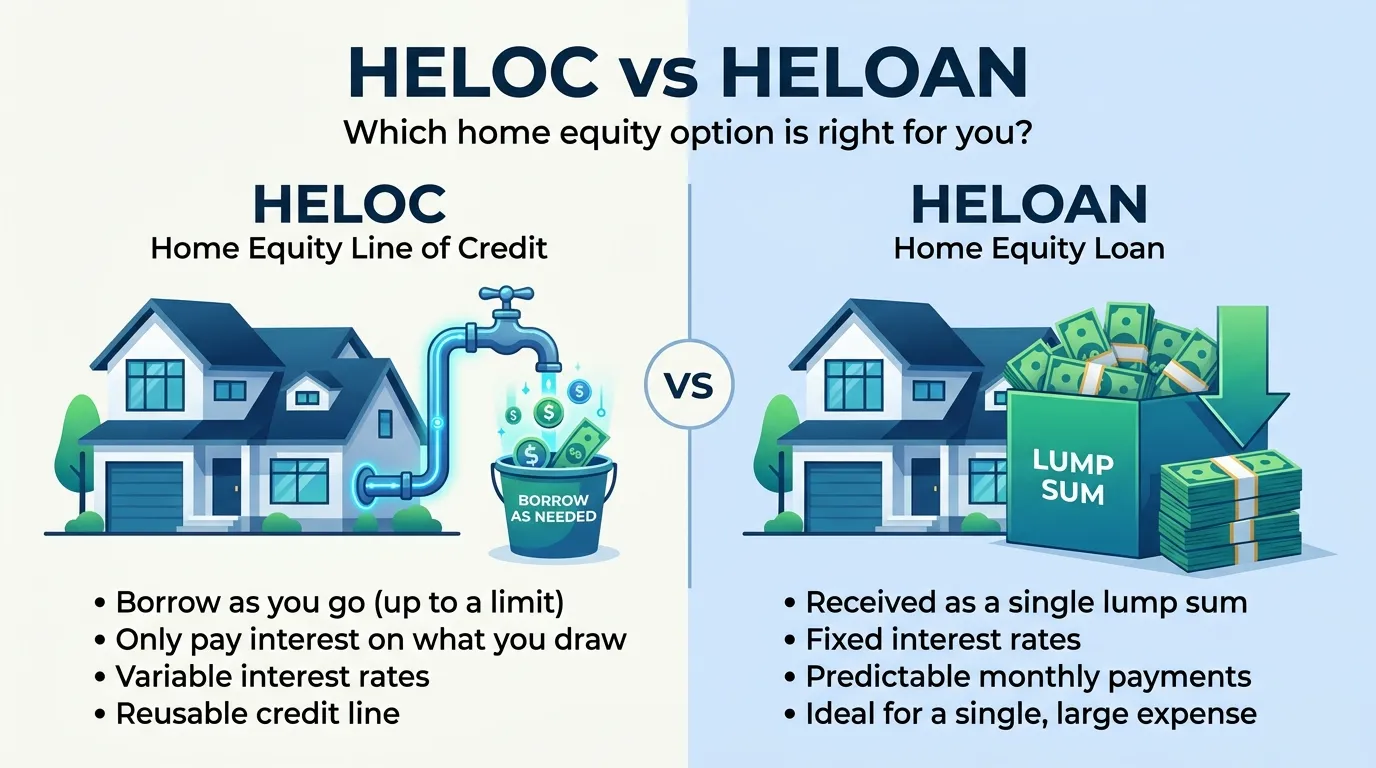
A HELOC lets you borrow money as you need it. A HELOAN gives you a set amount of money at one time. Both let you borrow against the value of your home.
Imagine you want to fix your home. You need money for a new roof, fresh paint, and new floors. You know some costs now, but other costs may come later. A HELOC may help because you can take money as you need it. A HELOAN may work better if you know the full cost at the start.
HELOC means Home Equity Line of Credit. HELOAN means Home Equity Loan. Home equity is the part of your home’s value that you own after you take away the debt you still owe on it.
People search for HELOC or HELOAN because both loans use home equity. But they work in different ways. One gives you access to money over time. The other gives you one set amount.
Knowing the difference can help you make a wise choice. You should compare the rates, fees, and monthly payments before you borrow. Both loans use your home as security. If you fail to pay, you could lose your home.
Pronunciation
HELOC
- US: Often said as “HEE-lock.”
- UK: The same sound may be used by people who know the term.
HELOAN
- US: Often said as “HEE-lohn.”
- UK: The same sound may be used.
These are short forms of loan names. Some people may say the full names instead.
Difference Between HELOC or HELOAN
1. How You Get the Money
A HELOC gives you a credit limit. You can take money from it when you need it. A HELOAN gives you the full loan amount at one time.
Examples:
- HELOC: You take $3,000 to fix your roof.
- HELOAN: You get $20,000 to pay for a full home repair.
2. How You Borrow
With a HELOC, you may borrow, pay some money back, and borrow again during the draw period. A HELOAN is usually a one-time loan.
Examples:
- HELOC: You use some money now and more next month.
- HELOAN: You get the full amount and pay it back over time.
3. Interest Rates
Many HELOCs have rates that can change. Many HELOANs have fixed rates. A fixed rate stays the same during the agreed term.
Examples:
- HELOC: Your rate may rise, so your payment may go up.
- HELOAN: Your fixed rate can help you plan your payments.
4. Monthly Payments
HELOC payments often depend on how much you borrow and the loan rules. HELOAN payments usually follow a set plan.
Examples:
- HELOC: You borrow $4,000 from a $20,000 credit line.
- HELOAN: You repay a $20,000 loan in set monthly payments.
5. Access to Money
A HELOC may let you take more money during its draw period. A HELOAN does not usually let you take more money under the same loan.
Examples:
- HELOC: You pay for roof work now and floor work later.
- HELOAN: You get the full amount for one planned job.
6. Best Uses
A HELOC may suit costs that change over time. A HELOAN may suit a job with a clear price.
Examples:
- HELOC: You fix different rooms over several months.
- HELOAN: You borrow a set amount to replace your roof.
7. Repayment Time
A HELOC often has a draw period and a repayment period. A HELOAN has a set time to repay the loan.
Examples:
- HELOC: You borrow during the draw period, then pay back the debt.
- HELOAN: You make monthly payments until the loan ends.
8. Planning Your Costs
A fixed-rate HELOAN may make it easier to plan your costs. A HELOC may cost more if its rate rises.
Examples:
- HELOC: A higher rate may raise your monthly payment.
- HELOAN: A fixed rate can help keep payments steady.
9. Fees
Both loans may have fees. These can include costs to open the loan or keep the account active.
Examples:
- HELOC: Ask if there is an annual fee.
- HELOAN: Ask about closing costs before you sign.
10. Risk to Your Home
Both loans use your home as security. If you do not pay, the lender may take steps that could lead to the loss of your home.
Examples:
- HELOC: Missed payments may put your home at risk.
- HELOAN: Unpaid debt may also put your home at risk.
Always read the loan terms before you choose.
Nature and Behaviour of HELOC and HELOAN
How a HELOC Works
A HELOC works like a credit line. The lender sets a limit. You can take money up to that limit under the loan rules.
You may use the money for home repairs or other needs. During the draw period, you may be able to borrow more after paying some money back.
When the draw period ends, you may need to start paying back the full amount you owe. Your payments may rise at this time.
How a HELOAN Works
A HELOAN gives you one set amount of money. You then pay it back over time.
Many home equity loans have fixed rates. This can help you plan your monthly costs. A HELOAN may suit you if you know how much money you need.
Why People Get Confused About HELOC or HELOAN
The names look alike. Both loans use home equity. Both can help pay for large costs.
The main difference is how you get the money. A HELOC lets you take money as needed. A HELOAN gives you one amount at the start.
The rates and fees may also differ. Always read the terms from the lender.
Comparison Table
| Feature | HELOC | HELOAN |
|---|---|---|
| Full name | Home Equity Line of Credit | Home Equity Loan |
| Money | Take it as needed | Get it at one time |
| Borrow again | Often possible during the draw period | Usually not under the same loan |
| Rate | Often changes | Often fixed |
| Payments | Depend on the balance and terms | Usually follow a set plan |
| Best use | Costs that change | A job with a set cost |
| Home as security | Yes | Yes |
Both let you borrow against your home equity. Both have risks.
Also read more about https://textlinkerpro.com/adapalene-or-tretinoin/
The Origin of the Terms
HELOC is short for Home Equity Line of Credit. It names a credit line backed by the value of your home.
HELOAN is used as a short form for Home Equity Loan. This type of loan gives you one set amount.
The full terms help explain how each loan works. HELOC is widely used in US financial writing. HELOAN may be less familiar to some readers.
British vs American English
HELOC and HELOAN are financial terms, not spelling forms that differ between British and American English.
In the US, people often use the terms HELOC and home equity loan. In the UK, lenders may use other names for loans linked to home value.
Examples:
- US: “I want to compare a HELOC and a home equity loan.”
- UK: “I want to ask my bank about borrowing against my home.”
Which One Should You Use?
The right choice depends on your needs and budget.
- Choose a HELOC if you need money in stages.
- Choose a HELOAN if you know the full cost.
- Consider a fixed-rate loan if you want steady payments.
- Compare all fees and rates before you agree.
A HELOC may give you more choice in when you borrow. But its rate may change. A HELOAN may be easier to plan for if it has a fixed rate.
Do not borrow more than you can pay back. Ask the lender to explain any terms you do not understand.
Common Mistakes
Here are some common mistakes to avoid.
- Mistake: Thinking a HELOC gives you all the money at once.
Correct: You can often take money as needed. - Mistake: Thinking a HELOAN works like a credit card.
Correct: It usually gives you one set amount. - Mistake: Thinking every HELOC has a fixed rate.
Correct: Many HELOC rates can change. - Mistake: Looking only at the monthly payment.
Correct: Check the fees and total cost too. - Mistake: Thinking your home is safe if you stop paying.
Correct: Both loans use your home as security.
Everyday Usage Examples
In an email:
- “Can you tell me the fees for a HELOC?”
- “Please send me the terms for a home equity loan.”
On social media:
- “I am learning how a HELOC differs from a home equity loan.”
- “Compare loan costs before you borrow.”
In news:
- “Some homeowners use a HELOC to pay for home repairs.”
- “A home equity loan gives the borrower a set amount.”
In formal writing:
- “The borrower should check the rate and fees.”
- “The loan is secured by the home.”
Usage Trends
HELOC is a common term in US financial news and loan guides. Home equity loan is also widely used. HELOAN may appear in some online pages, but it is less common.
People may search for these terms when they plan home repairs or need to compare loan choices. Interest rates and home prices can affect these choices.
Search trends may change over time. Before you borrow, use trusted sources and compare offers from lenders.
Metaphors and Similes
These terms do not have common figurative meanings. But simple comparisons can help explain them.
- A HELOC is like a tap: You can take money as needed.
- A HELOAN is like a box: You get the full amount at once.
- A HELOC is like a credit card backed by your home: You can borrow within a set limit.
These are only comparisons. The rules and risks are different from those of a tap, a box, or a credit card.
Connotative Meaning
HELOC and HELOAN have mostly neutral meanings. They name two types of loans.
Positive meaning: They may help pay for needed repairs.
Negative meaning: They can lead to debt and money stress.
Neutral example: “She compared a HELOC with a home equity loan.”
The loan itself is not good or bad for everyone. The cost and the ability to repay matter most.
Idioms and Proverbs
There are no common idioms made just for HELOC or HELOAN. But some well-known sayings can give useful advice.
- “Look before you leap.” Read the loan terms before you sign.
- “Count the cost.” Think about all costs before you borrow.
- “Live within your means.” Borrow only what you can repay.
These sayings are helpful reminders, not loan rules.
Literature and Movies
HELOC and HELOAN are financial terms. They are not common themes or names in well-known books and films.
You may find them in books about money, home buying, or debt. News stories may also explain how people use home equity loans.
A film about money problems may show the stress caused by debt. But this does not mean it talks about a HELOC or HELOAN by name.
For facts about these loans, trusted financial guides are a better source than films.
Why This Difference Matters
Knowing the difference can help you choose a loan that fits your needs.
A HELOC may help when costs change. A HELOAN may suit a job with a clear price. But you must check the rate, fees, and payment plan for both.
This is important because your home is used as security. If you fail to repay, you could lose your home.
Do not choose a loan only because the first payment looks low. Find out how much you may pay over the full loan term. Ask the lender questions before you sign.
Usefulness in Daily Life
You may need a loan to fix your roof, repair your home, or pay for a large job.
If you know the full cost, a HELOAN may suit you. If you need money at different times, a HELOC may offer more choice.
You can use these terms when you talk to a bank or compare loan offers. Knowing the full names can help you understand what the lender says.
Always check the full cost and make sure you can afford the payments.
Situational Preference
A HELOC may be better when you need money in stages. For example, you may fix one room now and another room later. You can take money as needed, within the loan rules. But the rate may change.
A HELOAN may be better when you know the full cost of a job. You get the money at one time and repay it over a set period. A fixed rate may help you plan your costs.
Both loans have risks. Compare the rates, fees, and payment plans. Choose the loan that fits your needs and your budget.
Possible Question
1. What is the main difference between a HELOC and a HELOAN?
A HELOC lets you take money as needed. A HELOAN gives you one set amount.
2. Is a HELOC the same as a home equity loan?
No. Both use home equity, but they work in different ways.
3. Can a HELOC rate change?
Yes. Many HELOCs have rates that can go up or down.
4. Is a HELOAN good for home repairs?
It may be a good choice if you know how much the work will cost.
5. Can I lose my home with these loans?
Yes. Your home is used as security for both loans. If you fail to pay, it may be at risk.
6. Can I borrow more money with a HELOAN later?
Usually, a HELOAN does not let you borrow again under the same loan. You may need to apply for new credit.
7. What should I check before I choose?
Check the rate, fees, monthly payments, and full cost. Make sure you can repay the loan.
Conclusion
HELOC or HELOAN are two ways to borrow money using your home equity. The main difference is how you get the money. A HELOC gives you access to a credit line. A HELOAN gives you one set amount at the start.A HELOC may suit you if your costs change over time. A HELOAN may work better if you know the full cost of your project. Many HELOCs have rates that can change. Many home equity loans have fixed rates.Before you choose, compare the rates, fees, and payment plans. Do not look only at the first monthly payment. Think about the full cost and whether you can afford to repay the loan.Most of all, remember that both loans use your home as security. If you fail to pay, you could lose your home. Read the terms with care and ask the lender questions if anything is not clear.

I’m Khadija Zafar, a content writer and blogger. I write simple, engaging articles on English grammar, word meanings, synonyms, antonyms, and vocabulary to help readers improve their English skills.